Picture this. Your CFO leans across the table and asks a simple question about your AI investment. “What did we get for it?”
You have the adoption dashboard. You know how many people logged into the Copilot last month. You have screenshots of impressive demos. You might even have a survey where employees said AI saved them “a few hours a week.”
None of that answers the question.
This is where most AI programs stall in 2026. Not because the technology is not working, but because the measurement system was never designed to capture how AI creates value. Kyndryl research found that 61% of business leaders feel more pressure to prove AI ROI than they did a year ago. Teneo found that 53% of investors expect positive returns within six months.
The expectation gap is real. And it is growing.
Key Takeaways
The Activity Metric Trap
Most organizations measure AI the way they measured SaaS adoption ten years ago. Logins. Usage minutes. Number of prompts sent. These are activity metrics. They tell you whether people are touching the tools. They tell you nothing about whether the tools changed a business outcome.
Gartner’s 2026 research put it bluntly: CEOs rank AI as the technology most likely to affect business outcomes, but executive leaders still quantify its value through activity metrics like “productivity” and “adoption rates” rather than tangible financial outcomes. We explored a similar pattern in AI Adoption: A Guide to Assessing Organizational Readiness; the gap between deployment and impact shows up early in the maturity curve.
A team might have 90% Copilot adoption. Impressive, on paper. But if the finance team is still manually reconciling invoices at the same error rate, what did that adoption produce? If the marketing team generates 3x more content but conversion rates stayed flat, is that ROI or just more noise?
Activity metrics are comfortable. They go up and to the right. They look good in a slide deck. They just do not answer the question your board is asking.
The Three Value Paths
I think the most useful way to think about AI ROI (and I changed my mind about this recently; I used to think it was all about time savings) is through three distinct value paths. Each one captures a different way AI creates business value, and most organizations only measure the first.
Path 1: Quality Lift. AI improves the outcomes of work that was already happening. Fewer errors in contract review. Better forecasting accuracy. Higher conversion rates on sales outreach. The work existed before AI. AI made it better. This is measurable through before-and-after comparisons on the KPIs the team already tracks.
Path 2: Scope Expansion. AI enables work that would not have happened otherwise. A three-person content team that now produces localized versions for twelve markets. An engineering team that runs security audits on every commit, not just the quarterly ones. AvidXchange’s 2026 survey found that 32% of high-performing finance teams are reinvesting AI gains into business expansion. The “impossible backlog” (work sitting in a spreadsheet because nobody had bandwidth) starts getting done. That is new value, and it requires its own measurement.
Path 3: Capability Unlock. AI removes a bottleneck that was constraining the entire organization. The compliance team that was the reason every product launch took 14 weeks? AI-assisted review cuts it to 4. That is not “time saved” for the compliance team. That is faster time-to-market for every product. The value shows up downstream, often in a completely different P&L line than where the AI was deployed.
If you want to see where your organization sits across all ten readiness dimensions before designing a measurement framework, the AI Readiness Assessment Matrix gives you a structured scoring system with industry benchmarks. It is free, and it takes about two hours.
Five Metrics That Survive the Board Room
Here is where this gets concrete. These five metrics work because they connect AI activity to financial language your CFO already thinks in. Each one maps to an existing business KPI, which means you do not need to invent new reporting infrastructure.
1. Cost-to-Serve Reduction. Pick a process where AI is deployed. Measure the fully loaded cost per unit of output before and after. A customer support team using AI triage can measure cost per resolved ticket. A finance team can measure cost per processed invoice. The denominator matters; cost per unit, not total cost. Headcount might stay the same while throughput doubles. That is still ROI.
2. Cycle Time Compression. How long does a process take from trigger to completion? Gartner notes that sales conversion rate and collection efficiency can show improvements within eight to twelve weeks with strategic AI use. Measure the before-and-after in days or hours, not in “percentage of employees using AI.” Time is money, and your CFO knows exactly how much.
3. Error Rate Reduction. Every error has a cost: rework, customer churn, compliance risk. AI that catches errors earlier or prevents them entirely creates measurable savings. Track defect rates, rework cycles, or exception volumes before and after AI deployment. A legal team catching contract clause issues before client review is saving real money, even if nobody counted those errors before.
4. Revenue Influence. This one is harder, and I want to be honest about that. Attributing revenue directly to AI is tricky because revenue involves many variables. But you can measure contribution to pipeline velocity, conversion rate lift, or expansion revenue per account. If your AI-assisted sales outreach converts at 12% instead of 8%, that influence is quantifiable even if it is not the sole cause.
5. New Capability Value. What can your organization do now that it could not do six months ago? If AI enables a new service line, a new market entry, or a new customer segment, that value is often the largest but the hardest to attribute. Frame it as: “This revenue/capability would not exist without the AI investment.” Elvex’s research found that 80% of organizations set efficiency as their AI objective, but the companies seeing the most value are those that also set growth or innovation objectives. The biggest ROI is often not in doing old things faster but in doing new things that were previously impossible.
As you think about how AI fits into your broader operating model, the Enterprise AI Operating Model Blueprint walks through six layers, from strategy to performance measurement. The performance layer is specifically designed for the kind of outcome tracking this post describes. Also free.
The Measurement Timeline
One mistake I see teams make constantly: expecting Year 1 metrics at Day 30. AI Smart Ventures documented outcomes across close to 1,000 organizations and found a clear pattern: measurement should be phased.
Days 1-30: Process Baseline. Before AI touches anything, measure the current state of every process you plan to augment. Cycle time, error rate, cost per unit, throughput. This baseline is essential. Without it, you are guessing about improvement. (I cannot stress this enough. Most teams skip this step and then spend months arguing about whether AI actually helped.)
Days 30-90; Leading Indicators. Track early signals: adoption quality (not just logins, but completion of tasks), time-on-task changes, user-reported friction. Look for the first evidence that workflows are shifting. We wrote about the broader maturity progression in The Maturity-Based AI Roadmap; measurement is what moves you from one stage to the next.
Quarter 2-4: Business Outcome Metrics. This is where the five metrics above start producing reliable data. Connect AI usage to business outcomes. Calculate fully loaded implementation cost against measured benefits. Most organizations achieve break-even in this window if the earlier phases showed genuine progress.
Year 1+; Strategic Value. Assess capability development and competitive positioning. Measure organizational AI fluency. Track whether AI enables strategies that were not previously possible.
Organizations that only measure Day 30 metrics will never demonstrate strategic value. Organizations that only set Year 1 targets will lose budget before they get there. You need both timelines running simultaneously.
For teams that are past the “should we” phase and into “how do we structure our AI rollout,” BTO’s 100 Claude Prompts for Real Estate Agents shows what applied AI looks like in a specific industry; every prompt tied to a real workflow with measurable output.
The CFO Translation Layer
Larridin’s 2025 report found that 72% of enterprise AI investments are destroying value through waste. Not because AI does not work. Because nobody measured whether it worked in terms the organization’s financial systems recognize.
The translation layer between “AI metrics” and “financial metrics” is where most measurement programs break down. Here is a quick reference for converting AI outcomes into CFO language;
Time saved per employee per week → annualized labor cost equivalent at fully loaded rate. Error reduction percentage → rework cost avoidance plus risk reduction value. Cycle time reduction → working capital improvement plus faster revenue recognition. New capability enabled → addressable market expansion or competitive moat.
Notice that none of these translations mention AI. That is the point. Your board does not care about AI. Your board cares about cost, revenue, risk, and competitive position. AI is the mechanism. The business outcome is the message.
Measurement Is Strategy
There is a pattern in how teams transition from automation to autonomy that applies here too; what you measure determines what you scale. If you measure adoption, you scale adoption. If you measure business outcomes, you scale impact.
The organizations pulling ahead in 2026 are not the ones with the most AI tools deployed. They are the ones who can answer the CFO’s question. Quickly. With numbers. In language that maps to the P&L.
Measurement is not a reporting exercise. It is how you decide what to double down on, what to stop doing, and where to invest next. Get it right, and AI becomes a strategic capability your organization builds on for years. Get it wrong, and next year’s budget conversation starts with “remind me what we spent $2M on?”
Start with the baseline. Measure outcomes, not activity. Phase your expectations. And always, always translate into financial language.
That is how you stop guessing.
Where to start
If you have never assessed your AI readiness, the first step is simpler than you think.
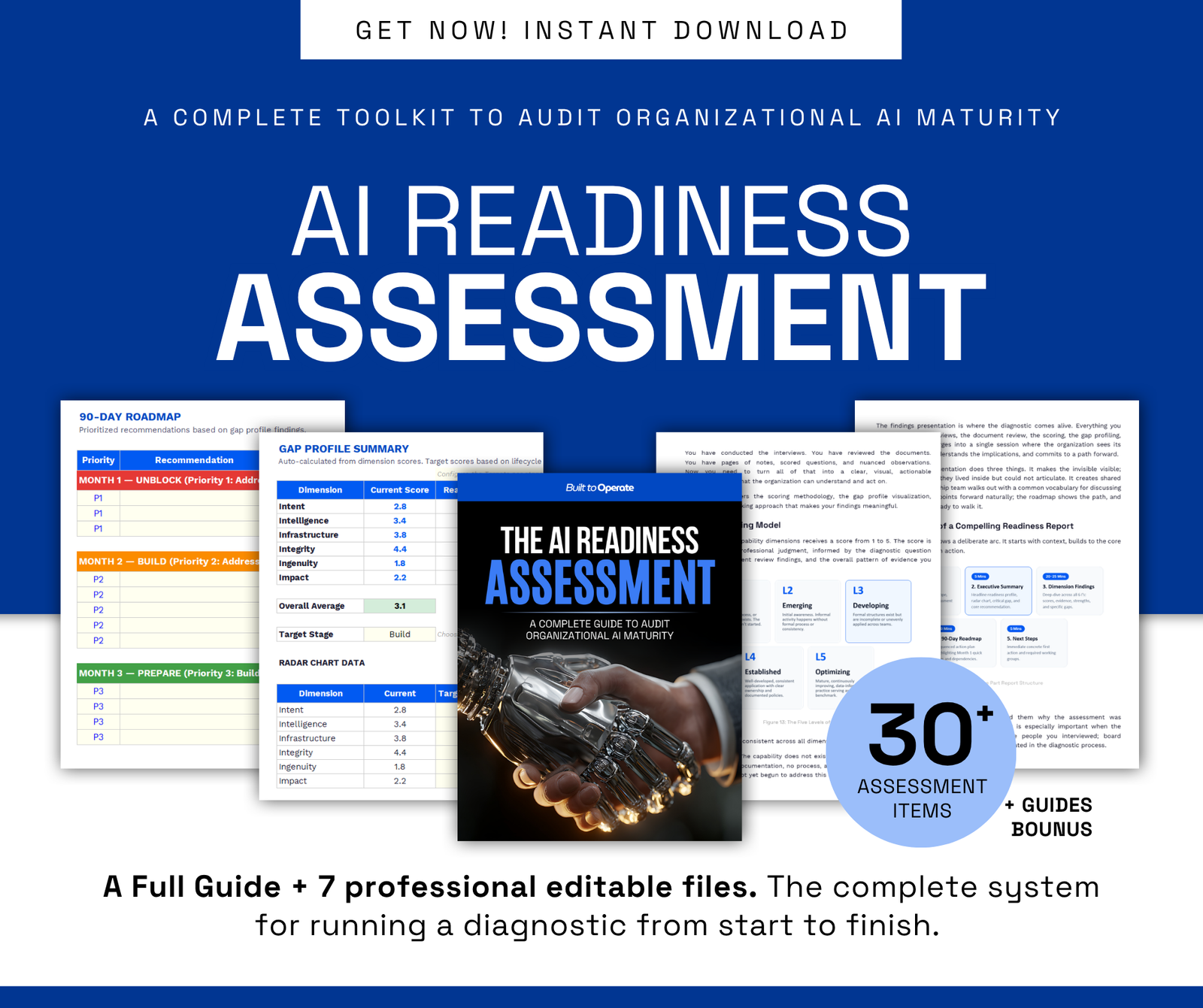
The full Assessment toolkit uses 30 scored questions with detailed rubrics, stakeholder interviews, document review, gap profiling, and a 90-day roadmap. It is designed to work whether you are assessing your own organization or helping someone else assess theirs. Get it in link below
The AI Readiness Diagnostic book covers the complete assessment methodology. The AI Readiness Assessment Toolkit includes the book plus 8 professional files; the Scoring Workbook, Interview Guide, Document Review Checklist, Findings Report Template, Executive Summary, 90-Day Roadmap Template, Findings Presentation, and Re-Assessment Tracker. Explore both at builttooperate.com.