Eighty-four percent of companies have deployed AI without redesigning a single job description.
That number comes from Arion Research’s analysis of the 2026 workforce data, and it explains something I keep seeing in organizations that should be further along than they are. The tools are there. The budget got approved. But the roles? The roles still describe a world that stopped existing about 18 months ago.
McKinsey now operates roughly 25,000 AI agents alongside its 40,000 human employees. Microsoft reports 15x year-over-year growth in active agents across Microsoft 365. Gartner projects 40% of enterprise applications will feature task-specific AI agents by the end of this year, up from less than 5% in 2025. The AI side of the equation is moving fast.
The human side? Deloitte’s 2026 Human Capital Trends report found that only 6% of leaders say they are making real progress designing human-AI interactions. Six percent.
This is not a technology problem. This is a job design problem. And if you are an HR leader, a people ops manager, or a team lead who has been told to “redesign roles for AI” without anyone explaining how, this post gives you a method.
Key Takeaways
Why Task-Level Is the Right Unit
The old question was: “Will AI replace this job?” It was the wrong question because jobs are bundles of tasks, and AI does not replace bundles wholesale. It changes which tasks inside the bundle are valuable.
A JLL survey of 2,200 C-suite leaders published in July 2026 found that 60% expect AI to reinvent roles rather than replace them. And the most AI-advanced organizations in the survey are actively redesigning roles to be enhanced by AI, not eliminated. They are also hiring more, not less. That second finding usually surprises people, but it makes sense once you see the task-level picture. When AI handles the routine, the humans who remain need to do more of the work that requires judgment, context, creativity, and relationship. That higher-value work generates more value, which funds more roles.
PwC’s 2026 Global AI Jobs Barometer describes this as a “two-track” labor market. In roles where AI handles routine tasks, the remaining human work becomes more judgment-intensive, better compensated, and harder to replace. In roles where AI has minimal impact, compensation growth is flatter. The wage premium for workers with AI-related competencies is now 56%, and that premium applies across functions, not just engineers.
The practical implication: if you are not redesigning roles, you are leaving both productivity and compensation potential on the table. We explored the broader readiness picture in AI Adoption: A Guide to Assessing Organizational Readiness, but the role-level work is where it gets specific and personal.
The 5-Step Role Redesign Method
This method works for any role, in any function, at any level. It takes about two hours per role. You can do it with a spreadsheet. No special tools required.
If you want a structured template with pre-built frameworks for each step, the Human-Machine Collaboration Handbook has the full task classification framework, role redesign worksheet, and collaboration archetypes ready to use.
Step 1: Audit Every Task
Sit down with the person in the role (or a small group if it is a common role) and list every task they perform in a typical week. Not responsibilities. Tasks. The specific things they actually do.
For each task, estimate three things: how many hours per week it takes, how much of it is repetitive versus judgment-based, and how visible the output is to the rest of the organization.
You will probably end up with 15 to 30 tasks. That is normal. Most roles are more complex than their job descriptions suggest, which is part of why this exercise matters.
One thing I have noticed: people consistently underestimate how much time they spend on coordination tasks (scheduling, status updates, routing information). Those tend to be high-frequency, low-value, and very AI-suitable.
Step 2: Classify Each Task
For every task on the list, assign one of four categories:
Automate fully. AI can handle this end-to-end with minimal human involvement. Examples: data entry, standard report generation, first-pass document review, email sorting, scheduling.
Augment with AI. The human still does this, but AI makes it faster or better. Examples: research synthesis, draft creation, data analysis, trend identification, customer response templates.
Keep human-only. This requires judgment, empathy, relationship, creativity, or physical presence that AI cannot replicate. Examples: difficult conversations, strategic decisions, creative direction, complex negotiations, mentoring.
Elevate. This is work the person should be doing more of but currently does not have time for. The freed-up hours from automation and augmentation go here. Examples: strategic thinking, client relationship building, innovation, coaching, cross-functional collaboration.
This classification is where the real insight happens. Most roles have 30% to 50% of their time spent on tasks that fall into the first two categories. That is a significant chunk of time that can shift to higher-value work.
Step 3: Identify the Focus Shift
This is the step most organizations skip, and it is the one that determines whether role redesign creates value or just creates confusion.
Ask: “If this person had 10 to 15 extra hours per week, what should they spend it on?”
The answer should come from business outcomes, not from the AI itself. If a customer success manager saves 12 hours a week on reporting and email triage, those 12 hours should go toward proactive account strategy, relationship building, or identifying expansion opportunities. The focus shift is where the role becomes more valuable, not just more efficient.
Microsoft’s 2026 Work Trend Index identifies four modes of working with AI: delegation, collaboration, asking, and exploration. Most organizations get stuck in “asking” mode (using AI like a search engine). The role redesign should push toward delegation (AI handles full tasks) and collaboration (human and AI work together on complex outputs). That distinction matters because it shapes what skills the person needs to develop.
This is also where things connect to the broader AI maturity conversation. We wrote about the sequencing challenge in The Maturity-Based AI Roadmap; the same principle applies at the role level. Start with the highest-impact focus shifts first.
Step 4: Rewrite the Role Description
Now rewrite the job description. But do it differently than you have done before.
Instead of listing tasks as core responsibilities, list the outcomes the role is responsible for and the judgment calls it requires. This is a shift the WEF Future of Jobs Report recommends explicitly: outcome-based role descriptions instead of task-based ones.
Include three new sections that traditional JDs do not have:
AI tools and systems used in this role. Be specific. Not “familiarity with AI tools” but “uses [specific tool] for [specific task].”
Human judgment required. Where in this role does the person make calls that AI cannot? What decisions require context, empathy, ethics, or creativity?
Growth trajectory. How will this role evolve as AI capabilities expand? What skills should the person be developing now for the version of this role that exists in 18 months?
That last section matters more than most HR teams realize. The skills required in AI-exposed jobs are changing twice as fast as in less-exposed roles, according to PwC. A static role description is already obsolete by the time it is published.
If you are redesigning multiple roles across a team or department, the AI Readiness Assessment Matrix gives you a structured way to assess whether the broader organizational conditions are in place for the redesign to succeed.
Step 5: Communicate the Change
This step is where role redesign either builds trust or destroys it. And frankly, it is where I think most organizations are weakest.
The communication should address three questions every employee has (whether they ask or not):
“Am I being replaced?” No. Here is specifically what you will do more of and what AI will handle.
“Will I be able to do this?” Yes. Here is the training and transition plan.
“What happens if it does not work?” Good question. Here is the feedback loop and the adjustment process.
Writer’s 2026 survey found that 54% of C-suite executives say AI adoption is tearing their company apart. That statistic reflects what happens when organizations deploy AI without communicating the role-level impact clearly. People fill the vacuum with worst-case scenarios.
The JLL survey found something encouraging on the other side: the most AI-advanced organizations are investing in entry-level talent and actively redesigning roles for enhancement. They are framing AI as a growth story, not a reduction story. That framing is not spin. It reflects what happens when role redesign is done well; the roles become more interesting, more autonomous, and more compensated.
We covered the broader workforce trends in 2026 AI Jobs Trends: Where AI Is Hiring Right Now, which gives useful context for the “where is this going?” conversation with your team.
One Thing to Watch: Entry-Level Roles
I want to flag something that does not get enough attention. Entry-level roles are disproportionately affected by AI because they contain the highest concentration of routine, process-heavy tasks. Those tasks were not just busy work; they were how new employees learned the business.
Reed’s 2026 workforce planning analysis warns that if employers do not redesign junior roles with care, AI could weaken the traditional pathways that develop future specialists. The panel recommended that organizations work more closely with education providers and redesign junior roles to emphasize learning through judgment-based tasks, not just task execution.
This is probably the most important long-term workforce design challenge in AI. I’m not entirely sure we have the answer yet. But the organizations that start thinking about it now will have a meaningful advantage over the ones that realize it in two years when their talent pipeline is thinner than expected.
The Pattern That Connects Everything
Twenty emerging agentic AI job categories were identified by Forbes, McKinsey, and LinkedIn in mid-2026. Split between technical roles (AI orchestrators, agent supervisors) and AI-augmented frontline roles in sales, service, HR, and operations. The non-technical roles will outnumber the technical ones. Most require no code.
That is the pattern. Role redesign is not about turning everyone into an AI engineer. It is about turning every role into a role where AI handles the routine and the human handles the judgment. The 5-step method in this post gives you a repeatable way to make that happen, one role at a time.
For a complete set of templates covering task classification, role redesign, collaboration archetypes, change management, and HR policy updates, grab the Human-Machine Collaboration Handbook. It was built for exactly this workflow.
If your team is past the “should we redesign roles?” stage and into “how do we redesign our entire operating model?”, the AI Governance Toolkit provides the governance framework, risk classification, and compliance structure that makes large-scale role transformation sustainable.
Start with one role. Run the five steps. See what shifts. Then do the next one.
Where to start
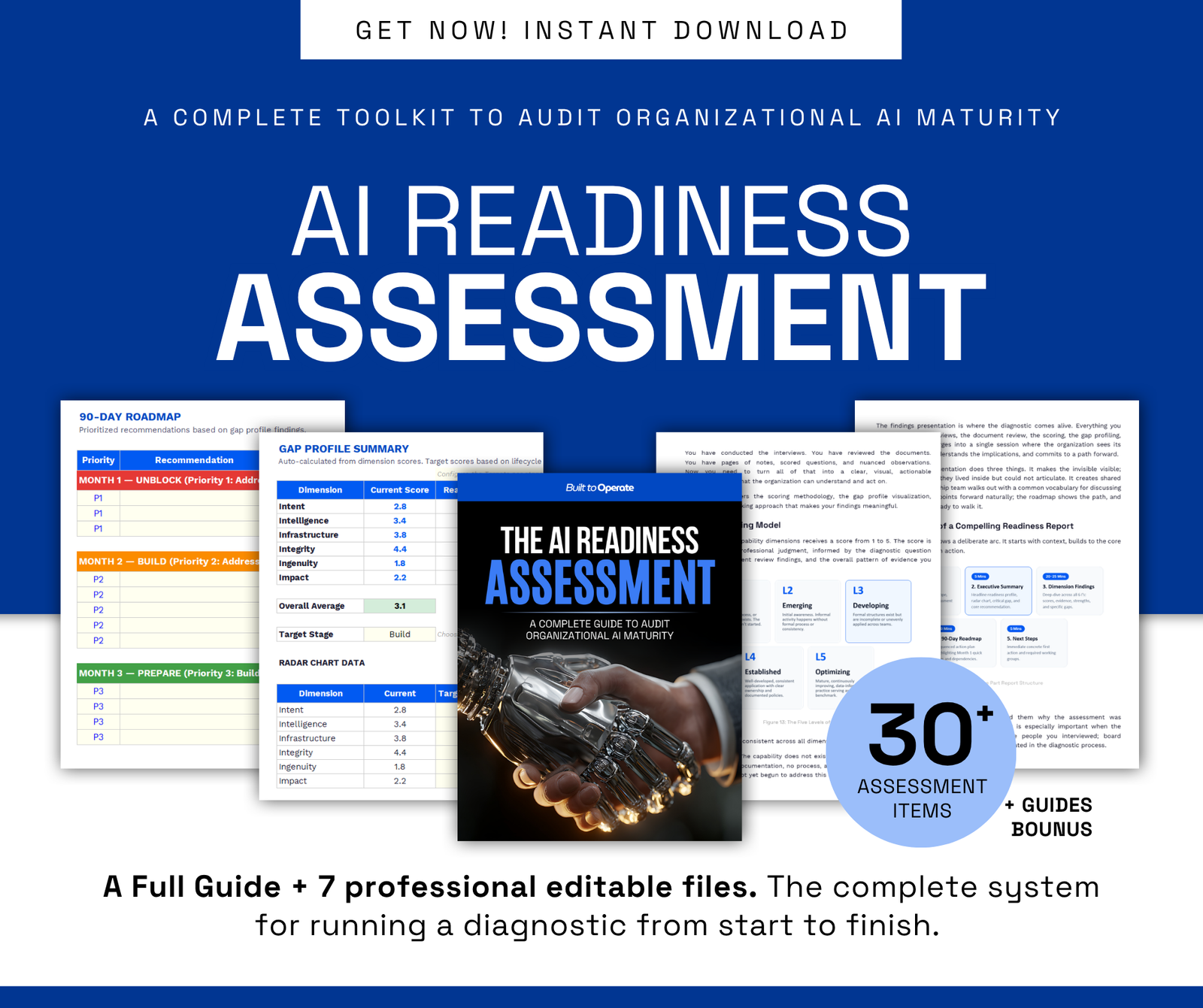
The full Assessment toolkit is designed to work whether you are assessing your own organization or helping someone else assess theirs. Get it at the link below
The AI Readiness Diagnostic guide covers the complete assessment methodology. And the AI Readiness Assessment Toolkit includes the book plus 7 professional files:
- the Scoring Workbook,
- Interview Guide,
- Document Review Checklist,
- Findings Report Template,
- Executive Summary,
- 90-Day Roadmap Template,
- Findings Presentation, and
- Re-Assessment Tracker. Explore both at The AI Readiness Assessment Toolkit