Uber’s CTO said it plainly this spring: “I’m back to the drawing board, because the budget I thought I would need is blown away already.” The company had rolled out Anthropic’s Claude Code to roughly 5,000 engineers in December 2025. By April, the entire 2026 AI budget was gone.

Four months. That is not a misforecast. That is a structural mismatch between how AI tools charge and how enterprises plan.
Uber is not a cautionary tale about reckless spending. It is a preview of what happens when a genuinely productive AI tool meets a finance model designed for a different era. Ninety-five percent of Uber’s engineers now use AI tools monthly. Seventy percent of committed code is AI-generated. Eleven percent of backend updates come from fully autonomous agents. The tools worked. The budget did not.
Key Takeaways
Why Token Pricing Breaks Everything
The problem is not that AI is expensive. The problem is that AI is priced in a way enterprise finance teams have never seen before.
SaaS runs on per-seat licensing. You buy 500 Slack seats, you know the annual cost within a few dollars. Cloud computing evolved FinOps over a decade to handle variable spend; auto-scaling alerts, per-team budgets, cost allocation dashboards. AI token pricing has the variability of cloud compute with none of the governance infrastructure.
An engineer running code autocomplete in a morning session might consume a modest number of tokens. That same engineer orchestrating parallel AI agents across a monorepo in the afternoon could generate an invoice ten times larger. Same tool. Same person. Same workday. The difference in cost is invisible until the bill arrives.
Monthly per-engineer costs at Uber ranged from $500 to $2,000 depending on workflow. Multiply that variance across 5,000 engineers and the math gets violent fast. Uber’s total R&D spend was $3.4 billion in 2025. The AI tools represented a significant and entirely unpredicted slice of that.
We explored the operating model challenges behind AI scaling in The Maturity Based AI Roadmap, and the budget crisis is exactly what happens when teams skip the governance layers.
Uber Was Not Alone
Microsoft reportedly canceled most of its internal Claude Code licenses six months after rolling them out. One unnamed company spent $500 million in a single month because nobody had set usage limits. These are not edge cases. A Mavvrik survey found that 85% of companies missed their AI cost forecasts by more than 10%. Eighty-four percent reported AI spending cutting gross margins by more than six percentage points.
Paul Roetzer from the Marketing AI Institute put it bluntly: budgets finalized in the fall of 2025 were obsolete by January. “No one I’ve talked to has any clue how to handle this.”
There is an uncomfortable irony here. Uber’s COO told Business Insider that higher AI usage was not translating into proportionally more useful features. The tools were productive enough to consume the budget but not productive enough (yet) to justify the spend on a per-feature basis. That gap between raw throughput and business value is where the real conversation needs to happen.
For teams trying to figure out where they stand on readiness, including financial readiness, the AI Readiness Assessment Matrix covers ten dimensions including governance and infrastructure maturity.
The Structural Problem
Most enterprises are still running AI adoption like a software rollout. Buy the tool. Give everyone access. Measure adoption rates. Celebrate the usage numbers. This works when the tool costs a flat fee per user. It falls apart when the tool meters every interaction.
The cloud computing world learned this the hard way over a decade. AWS bills in the early 2010s surprised a lot of CFOs. The industry built an entire discipline around it; FinOps. Cost tagging. Budget alerts. Reserved capacity. Spot instance strategies. None of that exists yet for AI token consumption. Enterprises deployed agentic coding tools the way they deployed Slack; casually, company-wide, without per-team cost ceilings or real-time monitoring.
The timing made it worse. Most 2026 budgets were locked in September 2025. Claude Code’s capabilities took off in late 2025 and early 2026. By the time adoption curves went vertical, the money was already allocated.
Forrester has predicted that 25% of planned enterprise AI spending will be deferred from 2026 to 2027 as CFOs demand hard ROI evidence and security teams flag unresolved governance gaps. That is a lot of stalled momentum.
The Response Is Arriving
The vendor side is moving. Anthropic launched enterprise spend controls on July 2, giving IT and finance teams model-level entitlements, spend-threshold alerts, and an analytics API that returns usage data filterable by team, product, and model. OpenAI slashed GPT-5.6 Luna pricing by 80% on July 30; from $1 to $0.20 per million input tokens. The price war is real, but lower per-token prices do not solve the governance problem. Cheaper tokens consumed at higher volume can produce the same bill.
What is interesting is that the CNBC coverage of the price cut described the end of “tokenmaxxing”; the era where employers encouraged staff to use as much AI as possible without tracking cost. That era lasted about 18 months. The correction is already underway.
We covered the governance side of this equation in AI Adoption: A Guide to Assessing Organizational Readiness, and the cost dimension is now the most urgent item on the readiness checklist.
What Teams Should Do Now
The practical takeaway is not “spend less on AI.” It is “know what you are spending, on what, and whether it is producing value.” The Enterprise AI Operating Model Blueprint includes a governance layer specifically designed for this; mapping cost controls to organizational structure.
Five moves that organizations making this transition well have in common:
Set per-team and per-engineer token budgets with real-time alerts, the same way cloud teams set compute budgets. It sounds obvious. Almost nobody is doing it yet.
Separate exploration spend from production spend. Engineers experimenting with new capabilities need room. Engineers running daily workflows against production codebases need cost ceilings. These are different budget lines with different governance.
Track cost per business outcome, not cost per token. “We spent $40,000 on AI this month” means nothing. “AI-assisted code reviews cost $12 per PR and reduced review time by 60%” is a number a CFO can act on.
Negotiate committed-use agreements. The per-token spot market favors the vendor. Volume commitments with price locks favor the buyer. Cloud computing figured this out in 2014. AI is catching up.
Audit usage patterns before cutting budgets. Uber’s 11% fully autonomous backend updates might be the highest-ROI AI spend in the company. The engineers using AI for casual autocomplete might be the lowest. Blanket cuts miss this distinction.
The organizations that treated AI governance as optional in 2025 are now learning it the expensive way. For teams that want to build governance before the bill arrives; rather than after; the AI Governance Toolkit provides ready-to-use policies, risk frameworks, and vendor assessment checklists that can be deployed in weeks, not quarters.
The Bigger Picture
This budget crisis is actually a signal that something is working. If AI tools were useless, there would be no spending problem. The fact that engineers adopted them so aggressively, so fast, that they overwhelmed financial models means the tools deliver genuine productivity. The challenge is organizational; can the business side keep up with the technology side?
I think the answer is yes, but only if finance teams treat AI spend with the same rigor they eventually brought to cloud spend. The discipline exists. The frameworks exist. What does not exist, yet, is the habit.
The companies that build AI FinOps discipline now will have a structural advantage for the next several years. The ones that wait will keep getting surprised by their own success.
Where to start
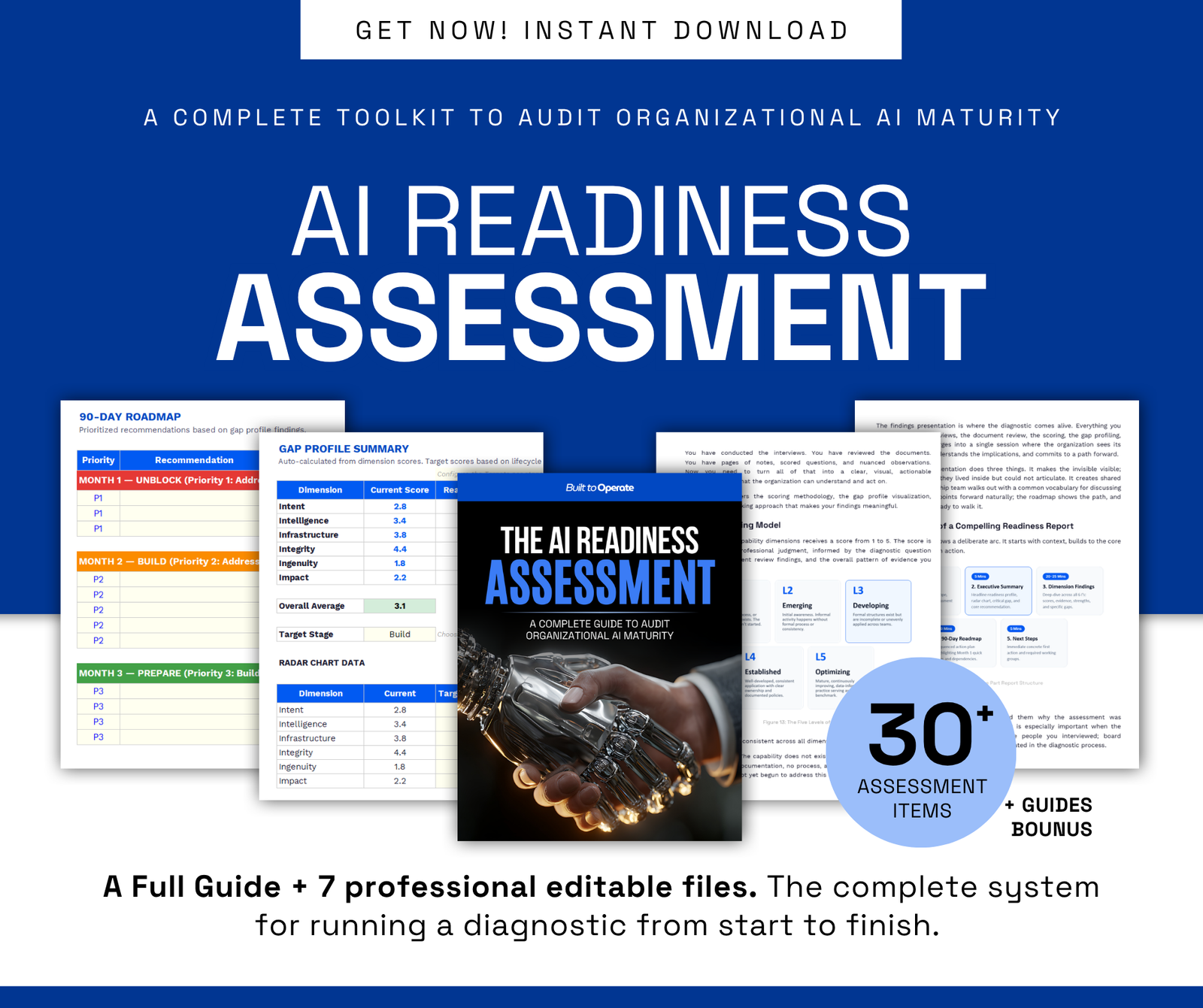
The full Assessment toolkit is designed to work whether you are assessing your own organization or helping someone else assess theirs. Get it at the link below
The AI Readiness Diagnostic guide covers the complete assessment methodology. And the AI Readiness Assessment Toolkit includes the book plus 7 professional files:
- the Scoring Workbook,
- Interview Guide,
- Document Review Checklist,
- Findings Report Template,
- Executive Summary,
- 90-Day Roadmap Template,
- Findings Presentation, and
- Re-Assessment Tracker. Explore both at The AI Readiness Assessment Toolkit