
A readiness diagnostic that produces a gap profile but no roadmap is like a health check that produces lab results but no treatment plan. The patient knows what is wrong. They have no idea what to do about it.
This is where most assessments fail. The findings are clear. The shape is visible. And then daily operations absorb everyone’s attention, and the findings sit untouched in a slide deck.
The 90-day roadmap is the bridge between diagnosis and action. It takes the gap profile, identifies the critical blocker, and sequences the work into three phases that create visible momentum.
Key Takeaways
Why 90 days
Ninety days is the right timeframe for three reasons. It is long enough to accomplish meaningful structural change; you can build a governance framework, redesign workflows, or launch a training program in 90 days. It is short enough to maintain urgency and accountability; people can hold a 90-day goal in their heads. And it aligns with quarterly planning cycles that most organizations already use.
Shorter timelines produce quick wins but not structural change. Longer timelines lose momentum and get overtaken by events. Ninety days hits the sweet spot.
Month 1: Unblock
The first 30 days focus entirely on the critical gap; the single dimension whose weakness prevents progress on everything else.
The goal is to remove the biggest blocker and create visible momentum. Month 1 recommendations should be high-impact, achievable actions that the existing leadership team can decide, resource, and execute within their current authority. No budget approvals. No organizational restructuring. Things that can happen now.
If Intent is the critical gap: Convene a strategy alignment session with key stakeholders. Define three to five specific AI use cases tied to business objectives. Assign executive sponsors.
If Integrity is the critical gap: Draft an interim AI governance policy covering approved tools, data handling rules, and deployment approval. Assign a governance owner. Map current regulatory obligations.
If Infrastructure is the critical gap: Run a data readiness audit for the highest-priority use cases. Identify critical integration points. Develop a technical remediation plan.
If Ingenuity is the critical gap: Launch an AI literacy program starting with the teams closest to planned deployments. Communicate leadership’s vision for how AI changes roles.
If Impact is the critical gap: Define success criteria and baseline measurements for the top AI initiative before it launches. Establish a measurement cadence.
Two to three recommendations at this tier. All starting within the first two weeks. All completing within 30 days.
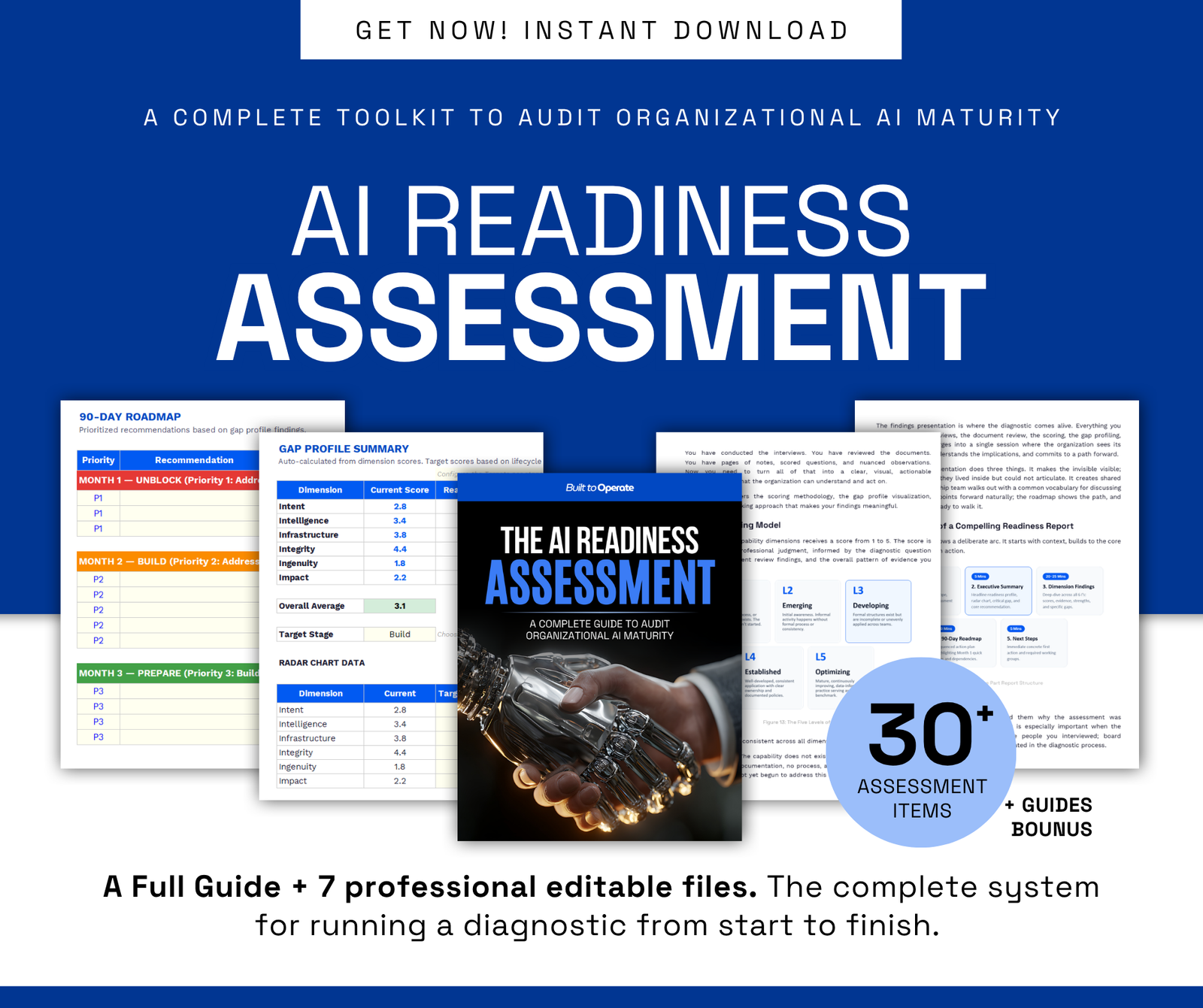
Month 2: Build
The second 30 days expand the focus from the critical gap to adjacent weaknesses. The organization is now working on multiple dimensions simultaneously, but with the critical blocker addressed or in progress.
Month 2 recommendations are bigger. They require cross-functional coordination and dedicated project ownership. Drafting governance frameworks. Conducting training programs. Redesigning workflows. Establishing measurement baselines.
The key discipline in Month 2 is maintaining focus. It is tempting to try to improve all six dimensions at once. Three to four active workstreams is the maximum most organizations can sustain alongside normal operations.
Three to five recommendations at this tier. Starting in week five. Running alongside ongoing Month 1 work.
Month 3: Prepare
The third 30 days shift to preparation for the next lifecycle stage. What will the organization need when it moves from Ready to Build, or from Build to Operate?
Month 3 recommendations build foundations that prevent the next set of gaps from forming. Establishing feedback loops. Designing measurement systems. Preparing change management infrastructure. Documenting processes. These are not urgent. But they are the investments that distinguish organizations that sustain AI progress from ones that stall after the first wave.
Month 3 also includes a checkpoint. Review progress on Months 1 and 2. Adjust the roadmap based on what has been learned. Set up the cadence for the next planning cycle.
Two to four recommendations at this tier. Starting in week nine. Continuing beyond the initial roadmap.
Quick wins and structural changes
Every roadmap needs both. Quick wins build confidence. Structural changes address root causes.
Quick wins are actions that can be completed in one to two weeks and produce a visible result. They are not trivial; they should genuinely improve something. But they are scoped to be achievable quickly. One-page AI use-case decision frameworks. Weekly 30-minute AI review meetings. Documented processes for top AI-candidate workflows. Interim usage policies.
Structural changes are initiatives that take four to twelve weeks and reshape how the organization operates. Comprehensive governance frameworks. Data architecture redesigns. Company-wide upskilling programs. Measurement systems with baselines and reporting cadences.
Front-load the quick wins in Month 1. Layer in structural changes in Months 2 and 3. The psychological pattern of early success followed by deeper transformation sustains organizational energy across the full 90 days.
Writing recommendations that get followed
Every recommendation should follow a consistent format that answers five questions.
What — a specific action, not a vague aspiration. “Draft and approve an AI data handling policy” not “improve data governance.”
Why — connected to the gap profile. “The Integrity score of 2 indicates no formal governance framework. Without one, each deployment carries unmanaged risk.”
Who — a named person or role responsible. Not “IT should” but “the CIO, in collaboration with the compliance officer.”
When — a specific time horizon. “Complete within the first 30 days.”
How you will know — a verifiable outcome. “An approved AI data handling policy exists and has been communicated to all AI project leads.”
Recommendations that answer all five questions get followed. Recommendations that skip the last three drift into organizational limbo.
After the 90 days
The roadmap is not a one-time document. At the 90-day checkpoint, three outputs should emerge. A progress map comparing the new gap profile to the original. An updated roadmap based on what has been learned. And a maturity trajectory projecting when key dimensions will reach their target levels.
That checkpoint is the beginning of the re-assessment cadence; the recurring practice that turns a one-time diagnostic into a continuous improvement system.
Where to start
If you have never assessed your AI readiness, the first step is simpler than you think.
The full Assessment toolkit uses 30 scored questions with detailed rubrics, stakeholder interviews, document review, gap profiling, and a 90-day roadmap. It is designed to work whether you are assessing your own organization or helping someone else assess theirs. Get it in link below
The AI Readiness Diagnostic book covers the complete assessment methodology. The AI Readiness Assessment Toolkit includes the book plus 8 professional files; the Scoring Workbook, Interview Guide, Document Review Checklist, Findings Report Template, Executive Summary, 90-Day Roadmap Template, Findings Presentation, and Re-Assessment Tracker. Explore both at builttooperate.com.