Gartner dropped a number recently that should change how every organization thinks about talent: the workforce skills half-life is shrinking to 2-5 years. Meaning the skills you invest in today will lose half their relevance before your next strategic planning cycle completes.
For AI skills specifically, it is moving even faster. The Bipartisan Policy Center’s AI Skills Dashboard found that US job postings requiring AI skills grew 144% year over year as of April 2026. Skills in AI-exposed roles are evolving 66% faster than in other positions. The prompt engineering techniques that were cutting-edge in January 2025 are table stakes by mid-2026.
Most organizations respond to this with training programs. Lunch-and-learns on prompt writing. Coursera subscriptions. Internal AI champions. These are not bad moves. Coursera’s 2026 report shows 234% year-over-year growth in generative AI enrollments among enterprise learners; clearly there is appetite. But training individuals is only half the equation, and probably the smaller half.
Key Takeaways
The Part Most Organizations Miss
Deloitte’s 2026 Global Human Capital Trends report surfaced something that should redirect a lot of AI transformation budgets: organizational factors like culture, management support, and governance account for more than twice the variance in AI impact compared to individual skill or mindset.
Read that again. The organization’s readiness matters more than the individual’s capability. By a factor of two.
Only 6% of leaders say they are making real progress designing how humans and AI should work together. Six percent. That means 94% of organizations are training people to use tools inside workflows that were never redesigned for those tools.
We explored the specific AI job trends for 2026 in 2026 AI Jobs Trends: Where AI Is Hiring Right Now. The hiring data is clear about which roles are growing. This piece is about a different question: whether organizations are ready to absorb those roles productively.
It is the difference between giving every employee a power drill and actually redesigning the assembly line.
The Salary Signal
The labor market is already pricing this in. Professionals who demonstrate AI proficiency earn 20-40% more than peers in equivalent roles. That premium is consistent across industries. It is the market’s way of saying: AI skills create measurable value, and there are not enough people who have them.
Half of US tech job postings now require AI skills. That number was negligible three years ago. The shift from “nice to have” to “required” happened in roughly 18 months.
The 50 AI Career Prompts guide was designed exactly for this moment; 50 structured reflection prompts across 7 career dimensions to help professionals figure out how AI changes their specific role, industry, and trajectory.
At the same time, the job creation side of the equation is substantial. AI is expected to create 170 million new roles globally by 2030. Many of these roles did not exist in 2023. AI operations manager. Prompt engineer. Agent orchestration specialist. AI governance analyst. The vocabulary of work is expanding at the same pace as the technology.
Redesigning Work, Not Just Skills
The 94% stat from Deloitte bothers me more than the skills gap numbers. Because it means almost every organization is approaching AI workforce transformation backwards.
The common approach: train people on AI tools, then hope the workflows adapt. The effective approach: redesign workflows around AI capabilities, then train people to operate the new workflows. Order matters.
The Human-Machine Collaboration Handbook includes a task classification framework (Automate, Augment, Elevate, Create, Protect) and role redesign worksheets for exactly this process. It breaks down how to analyze each role at the task level and determine which tasks AI should handle, which it should assist with, and which should remain entirely human.
We covered the broader operational question of when and how to transition AI across different maturity stages in Automation, Autonomy, & Adaptation. The workforce dimension is the one that determines whether those transitions create value or just create confusion.
Consider what happened at Meta. The company built an algorithmic redundancy scoring system that identifies overlapping skill sets and roles where AI could handle 80-95% of throughput. QA, content moderation, recruiting screening, first-pass code review. These are not entry-level positions being eliminated randomly. They are specific task clusters being identified for AI replacement based on measured overlap.
That kind of precision; role-by-role, task-by-task analysis; is what separates organizations that reshape work productively from organizations that do blanket layoffs and hope the remaining team figures it out.
The Two-Wave Pattern
AI job disruption is not one event. It is two waves. The first wave (2024-2026) is targeting routine cognitive tasks: data entry, basic analysis, content moderation, simple code review, customer service scripts. This wave is well underway. In 2025, 55,000 job losses were explicitly tied to AI; twelve times the number from two years earlier.
The second wave (2027-2030) will target more complex cognitive and physical tasks as AI reasoning and robotics improve. This is the wave most organizations are not preparing for. It will affect roles that currently feel safe: middle management decision-making, complex analysis, creative direction, strategic planning support.
The interesting countermove in the Coursera data: alongside the 234% spike in AI enrollments, critical thinking enrollments grew 120%. Organizations are investing in both AI literacy and the human judgment skills that AI cannot replace. That is a smart hedge.
What Organizations Should Do Now
The AI Readiness Assessment Matrix includes a talent readiness dimension with industry benchmarks for this reason; because workforce readiness is one of the ten dimensions that determine whether AI transformation succeeds or stalls.
Four priorities that the data supports:
Redesign workflows before training. Analyze each role at the task level. Identify which tasks AI should automate, augment, or leave alone. Then build training around the redesigned role, not the old one.
Build career transition pathways. For roles being restructured, create clear paths to emerging roles within the organization. The companies that build internal mobility pipelines will retain institutional knowledge. The companies that do layoffs without transition support will lose it.
Track cost per AI-augmented outcome. “We trained 500 people on AI” is a vanity metric. “AI-augmented analysts produce reports 40% faster with 15% higher accuracy” is a business outcome. Measure the outcome, not the training completion rate.
Invest in judgment, not just prompts. AI can generate, summarize, and analyze. It cannot exercise judgment about what matters, what is ethical, or what the right tradeoff is. Critical thinking, ethical reasoning, and domain expertise are the skills that compound in value as AI handles more of the mechanical work.
We mapped the full lifecycle of AI organizational design in The Maturity Based AI Roadmap. Talent readiness sits alongside governance, infrastructure, and strategy as one of the pillars that needs to be in place before scaling.
The Real Risk
The biggest career risk in 2026 is not that AI will take your job. It is that you will not develop the skills to do your job alongside AI, and your employer will not redesign your role to make that collaboration productive.
The Enterprise AI Operating Model Blueprint includes a talent layer with CoE role definitions, change management models, and an AI literacy program design specifically for organizations trying to get this right at scale.
Both sides of the equation need to move. Individuals need to treat AI proficiency as essential as spreadsheet proficiency was in 2005. Organizations need to treat workflow redesign as essential as digital transformation was in 2015. Neither alone is enough.
The 2-5 year shelf life means this is not a one-time initiative. It is a continuous practice. The teams and organizations that build that practice now; who redesign work, upskill continuously, and measure AI’s contribution to business outcomes; will compound their advantage every year.
Where to start
The full Assessment toolkit is designed to work whether you are assessing your own organization or helping someone else assess theirs. Get it in link below
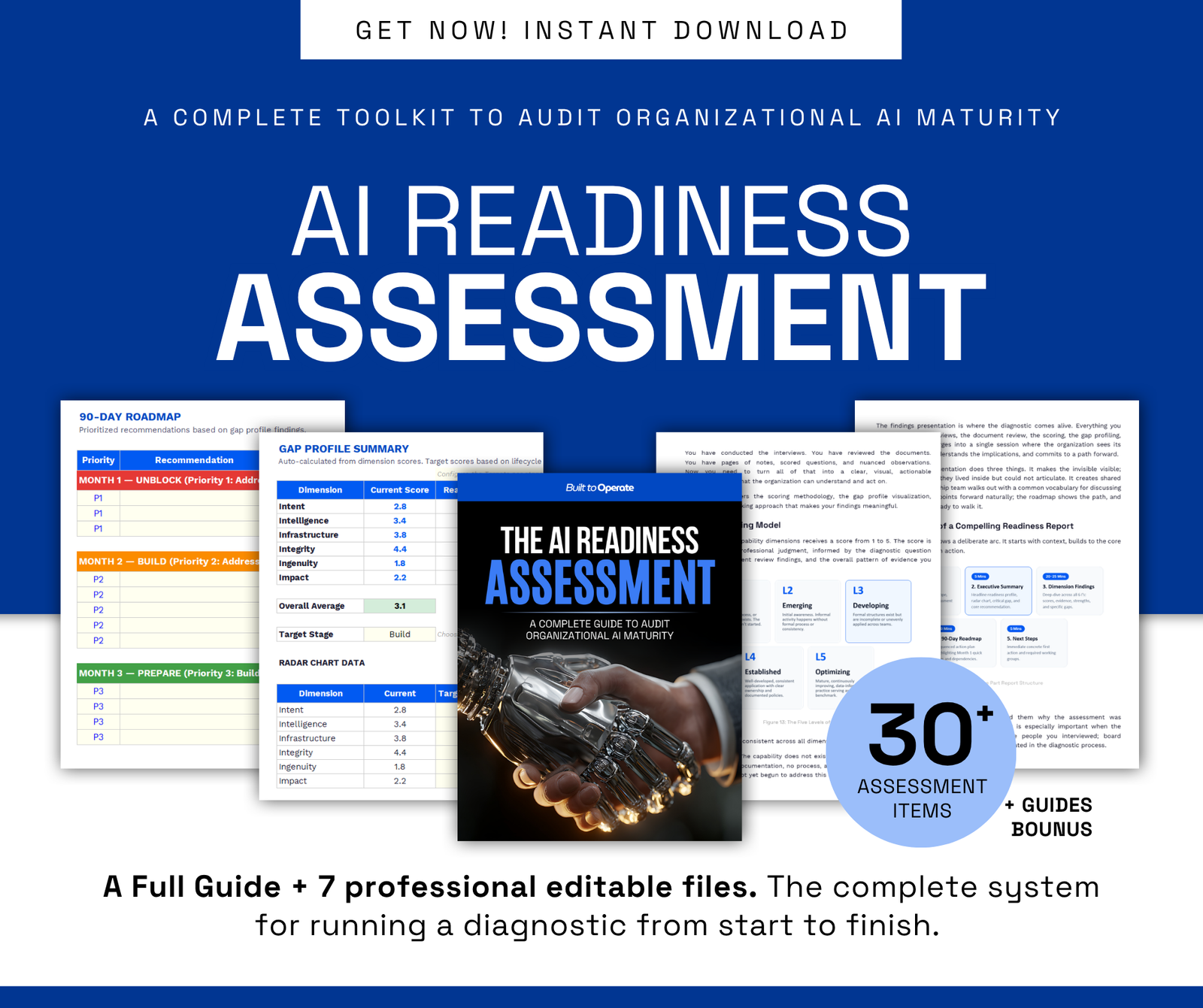
The AI Readiness Diagnostic guide covers the complete assessment methodology. And the AI Readiness Assessment Toolkit includes the book plus 7 professional files:
- the Scoring Workbook,
- Interview Guide,
- Document Review Checklist,
- Findings Report Template,
- Executive Summary,
- 90-Day Roadmap Template,
- Findings Presentation, and
- Re-Assessment Tracker. Explore both at The AI Readiness Assessment Toolkit