For two years, the enterprise AI conversation started and ended with OpenAI. ChatGPT launched. Everyone scrambled. GPT-4 became the default. If someone asked “which AI should we use,” the answer was OpenAI; almost by reflex.
That reflex just broke. Ramp’s 2026 spending data shows Anthropic at 34.4% of business AI spending share versus OpenAI at 32.3%. First time Anthropic has ever led in this dataset. The gap is small, but the direction is not.

Before anyone crowns a winner: this is not that kind of story. OpenAI still leads in total revenue by most estimates. ChatGPT passed one billion active users in July. The Ramp data measures something specific: what US mid-market and growth-stage companies are spending on AI when they choose freely. And increasingly, they are choosing Anthropic.
The more interesting question is why.
Key Takeaways
What Shifted
The crossover did not happen in a single quarter. It was cumulative. Claude 3 in early 2024 started closing the gap. Claude 3.5 Sonnet in mid-2024 accelerated it. By the time developers had lived with Sonnet for six months, the word-of-mouth had translated into procurement decisions.
Three things drove the shift in developer preference, according to MindStudio’s analysis: reliability on complex instructions, long-context reasoning performance, and coding quality. These are not flashy features. They are workday features. The kind of thing that determines whether a developer reaches for Tool A or Tool B at 2 pm on a Tuesday.
Claude 3.7 Sonnet outperforms GPT-4o on several coding and long-document benchmarks. GPT-4o has advantages in multimodal capabilities (voice, image generation) and ecosystem breadth. For text-heavy workflows, document analysis, and coding agents, Claude has become the preferred choice for many development teams.
We explored the broader question of how teams select AI tools in AI Adoption: A Guide to Assessing Organizational Readiness. Tool selection is one dimension, but it only produces results when the surrounding readiness (governance, data, processes) is in place.
What Each Provider Optimizes For
The market is no longer “OpenAI vs everyone.” It is a three-way (at least) competition where each provider has made different strategic bets.
Anthropic optimized for trust and developer experience. Safety positioning, constitutional AI, enterprise governance features (Cowork, Skills, Managed Agents all went GA in April 2026), and strong coding performance. The developer-first strategy means Anthropic wins adoption bottom-up; engineers choose Claude, then the procurement team catches up.
OpenAI optimized for scale and ecosystem. One billion users. Two million businesses. Codex handling 99.8% of weekly output tokens internally. The consumer-to-enterprise pipeline is enormous. OpenAI’s bet is that ubiquity wins; that being the default in consumer use translates to enterprise stickiness.
Google optimized for infrastructure. Custom Ironwood TPUs, the Gemini Enterprise Agent Platform (launched at Cloud Next 2026), and the argument that the company owning the full stack from chip to application can offer economics nobody else can match. Google’s pitch is vertical integration; one vendor for silicon, model, platform, and productivity suite.
None of these strategies is wrong. They serve different buyer profiles.
For teams evaluating which approach fits their operating model, the Enterprise AI Operating Model Blueprint includes a strategic choice framework for positioning AI investment that maps provider strategies to organizational needs.
The Governance Dimension
Something worth noting separately: an OutSystems survey of 1,900 IT leaders found that 89% of business teams are now using AI agents but only 12% say they can govern them.
That governance gap is where the provider competition is heading next. OpenAI moved Workspace Agents to credit-based billing on July 6. Anthropic launched enterprise spend controls on July 2. Google is positioning governance at the infrastructure layer.
The question is shifting from “which model is smartest” to “which provider helps me control what I have deployed.” This is a maturity signal. It means the market has moved past the “let’s try AI” phase and into the “let’s run AI responsibly at scale” phase.
We covered how teams transition through these maturity stages in Automation, Autonomy, & Adaptation. The governance tools that providers are shipping now directly support that transition.
What This Means for Your AI Vendor Strategy
A few practical implications:
The default has dissolved. “Use OpenAI because everyone uses OpenAI” is no longer the safe recommendation. The safe recommendation is “evaluate providers based on your specific workloads, governance needs, and operating model.”
Multi-model is becoming standard. The companies I talk to are increasingly running Claude for coding and document work, GPT for multimodal tasks, and evaluating Gemini for infrastructure-integrated workflows. This is not indecision. It is rational portfolio management; the same logic enterprises apply to cloud providers.
The AI Readiness Assessment Matrix includes an intelligence readiness dimension that covers exactly this kind of tool selection question; mapping capabilities to organizational needs rather than picking the highest-ranked name.
Developer preference leads procurement. The Ramp data reflects bottom-up adoption. Engineers chose Claude for their daily work, and spending followed. If you are making vendor decisions top-down without understanding what your developers are actually using (and why), you might be buying one thing while your team builds on another.
Price is a competitive weapon now. OpenAI cut GPT-5.6 Luna pricing by 80% on July 30. The AI price war has collapsed costs by 90-97% for equivalent capability since 2024. This favors buyers. But cheaper tokens do not solve the governance, reliability, or context-quality questions that drive developer preference. Choosing on price alone is like choosing a cloud provider on per-hour compute rates alone; it misses the operational picture.
We mapped the full maturity journey from initial AI selection through scaled deployment in The Maturity-Based AI Roadmap. Provider selection sits at the foundation layer, and getting it right early saves significant rework later.
The Real Signal
The Ramp crossover is not a verdict on which provider is “best.” It is a signal that the enterprise AI market has matured into a genuine multi-vendor ecosystem. The comfortable consensus that one provider dominates is gone. In its place: a market where teams need to make informed, operating-model-driven vendor decisions.
That is actually good news. Competition drives price reduction, feature acceleration, and governance investment. The AI Governance Toolkit includes a vendor assessment checklist scored across 12 criteria; useful for teams running a structured evaluation rather than going with the most familiar name.
The teams that treat provider selection as a strategic operating decision- matching their workloads, governance requirements, and deployment model to the right vendor- will outperform the ones that are still defaulting to a brand.
Where to start
The full Assessment toolkit is designed to work whether you are assessing your own organization or helping someone else assess theirs. Get it in link below
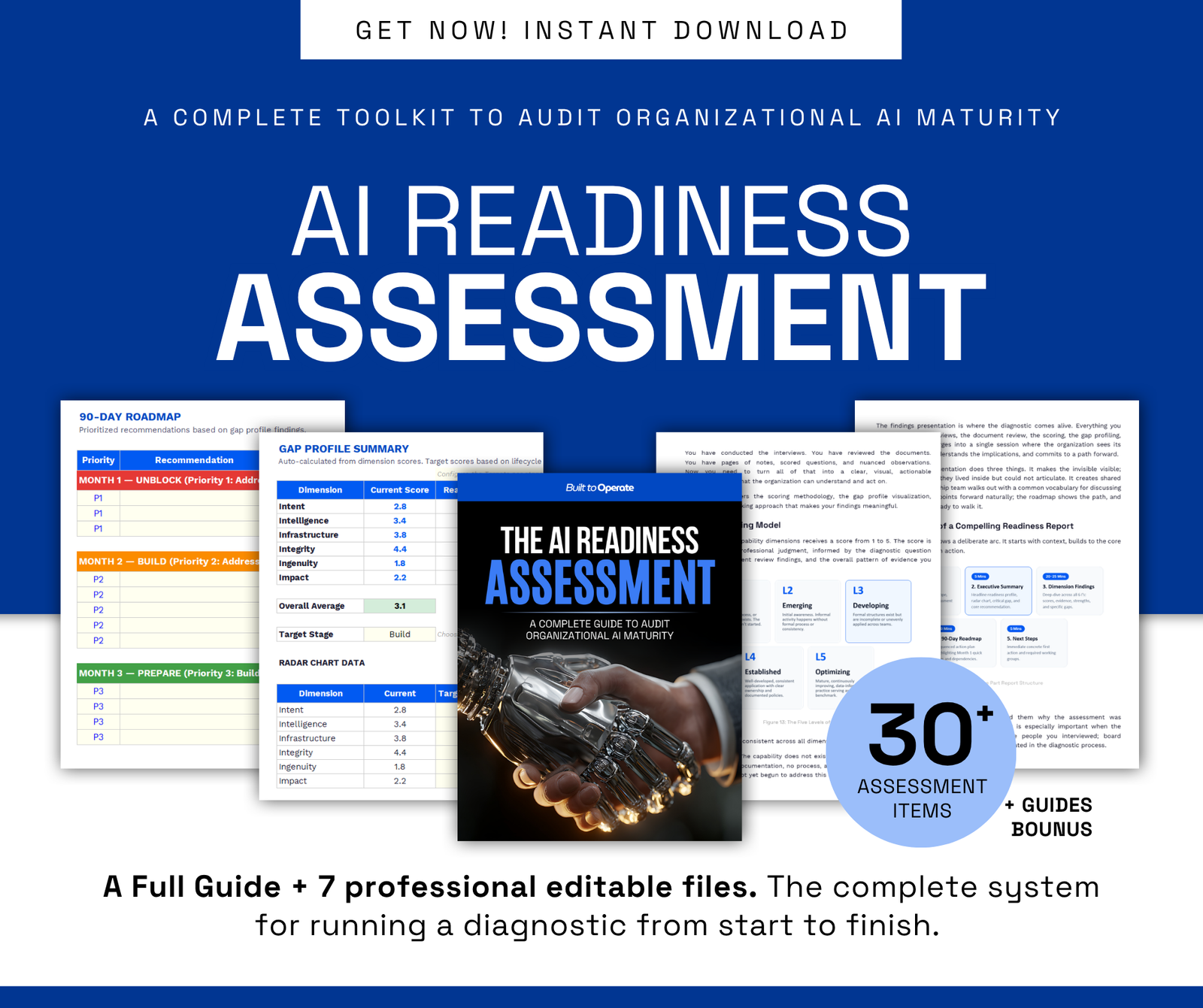
The AI Readiness Diagnostic guide covers the complete assessment methodology. And the AI Readiness Assessment Toolkit includes the book plus 7 professional files:
- the Scoring Workbook,
- Interview Guide,
- Document Review Checklist,
- Findings Report Template,
- Executive Summary,
- 90-Day Roadmap Template,
- Findings Presentation, and
- Re-Assessment Tracker. Explore both at The AI Readiness Assessment Toolkit