
AI is making the manager’s job bigger. Most companies are budgeting as if it’s getting smaller.
That mismatch shows up clearly in Workday’s Global Workforce Report, published October 5. Only 28% of business leaders expect AI to reduce headcount. A larger group, 40%, expect it to help them get more out of the people they already have. In other words, the jobs stay and the work inside them changes.
Someone has to redesign that work, team by team. In most organizations, that someone is a manager.
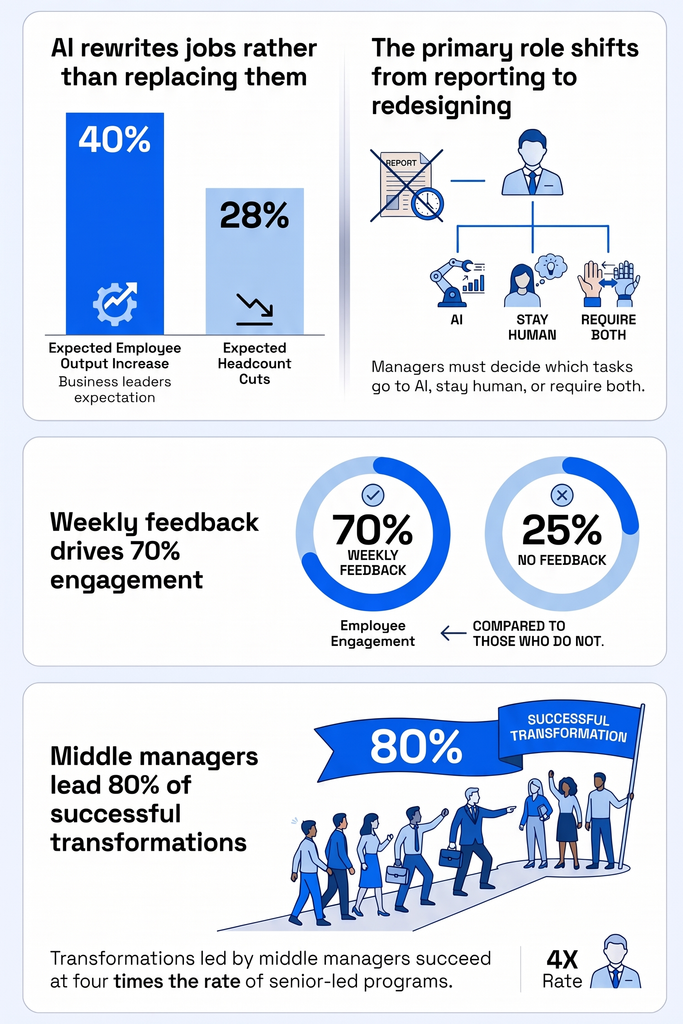
Table of Contents
Why are companies flattening management right now?
The case for fewer managers is strong, and it deserves a fair hearing.
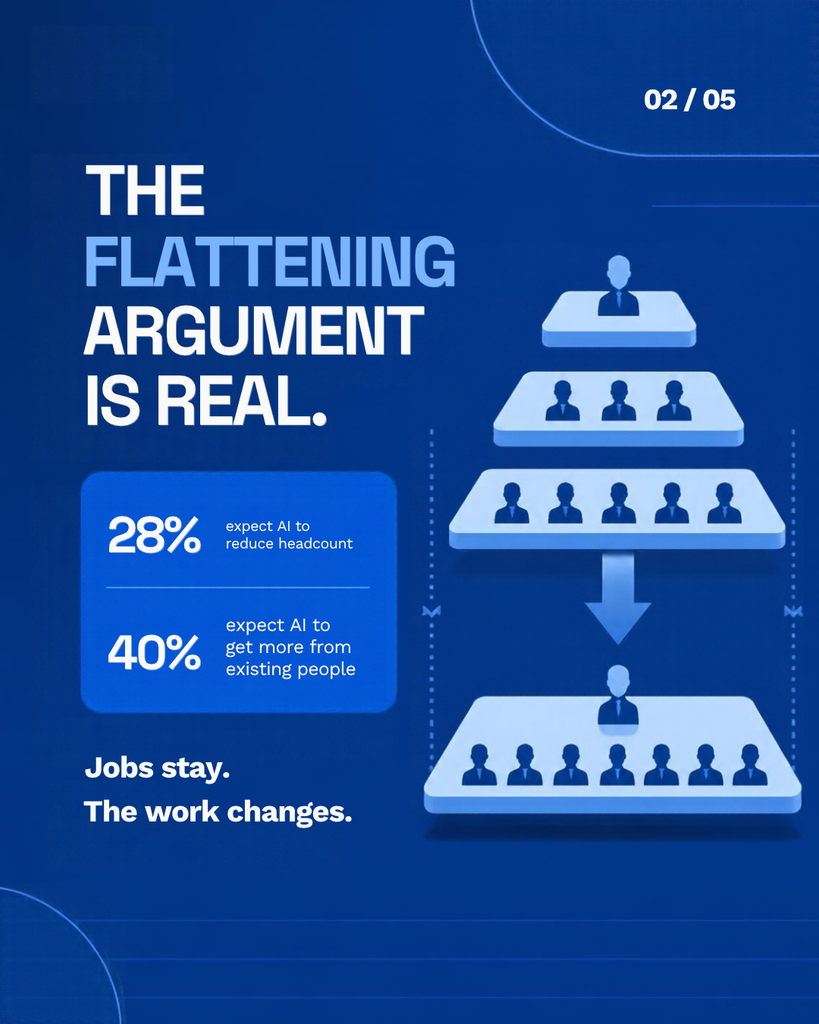
Citi cut its management layers from 13 to 8, and Fortune reports the bank posted its highest quarterly revenue in a decade this spring. Meta reportedly runs a 50-to-1 employee-to-manager ratio on a new applied AI team. Coinbase has moved to ratios of up to 15-to-1. Gallup’s span of control research shows the average manager now has 12.1 direct reports, up from 10.9 a year earlier. That’s nearly 50% higher than in 2013.
AI makes this easier. A big share of traditional management work is coordination: status updates, meeting notes, scheduling, first-pass reviews, chasing approvals. Deloitte found nearly 40% of managers’ time goes to firefighting or admin. Assistants handle much of that well. If a manager’s week is mostly relaying information, a good AI setup can relay it faster.
Gartner went further. It predicted that through 2026, one in five organizations would use AI to flatten and remove over half their middle-management roles.
All of that is real. I don’t think flattening is a mistake in itself. Some layers existed only to pass messages up and down.
What does the flattening argument leave out?
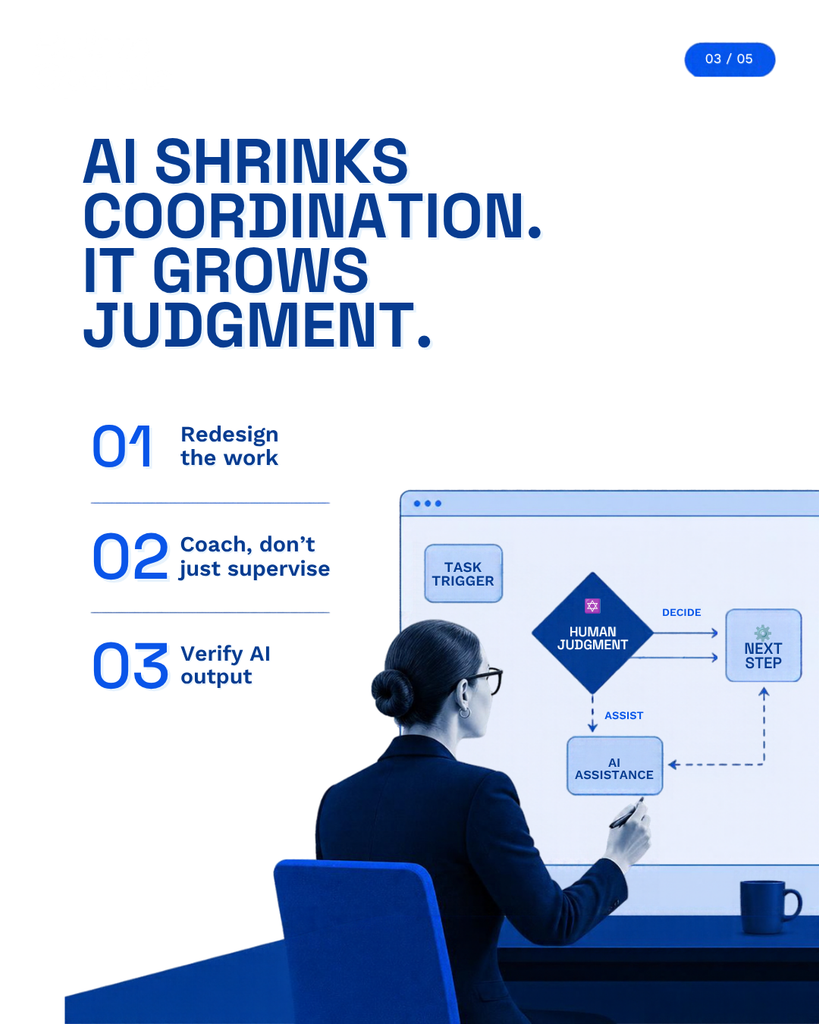
It treats management as coordination. Coordination was always only part of the job, and AI is shrinking that part while the rest grows.
Look at what else is in the Workday data. Mentions of management and leadership skills in job postings fell 7% over the past year. Training skills fell 13%. Internal moves dropped at 57% of employers, and promotion rates were flat worldwide. Nearly four in ten employees went through a reorganization.
Jobs are changing underneath people and the paths to new roles are narrowing. Meanwhile, employers ask less often for the skills that help people through change. Workday’s own Phil Willburn put it plainly: “Employees may not be changing jobs, but their jobs are changing around them.”
Here’s my read. Every team is now redesigning its own workflow at once. That redesign is local work. It needs someone who knows which tasks are tedious and which carry risk. It also needs someone who notices which person is quietly anxious about all of it. A central AI team can’t hold that context for 200 teams. A manager can hold it for one.
We laid out the task-by-task method in How to Redesign Any Role for AI in 5 Steps. Notice who runs it: the person closest to the work.
What does the new manager job look like?
Three shifts stand out. They don’t replace the old job overnight, and they won’t look identical in every team.
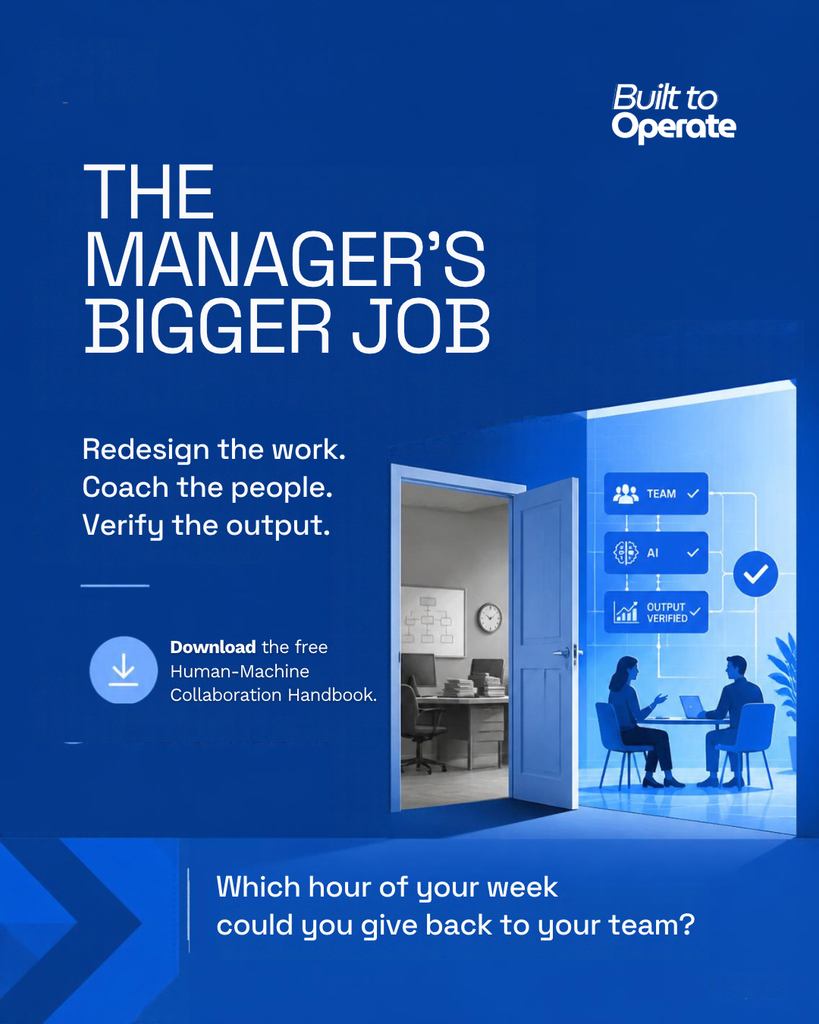
From reporting status to redesigning work. The manager’s main output becomes a better workflow. That means deciding which tasks go to AI, which stay human, and which need both. The free Human-Machine Collaboration Handbook is a practical place to start. It pairs a task classification framework with a role redesign worksheet you can grab and use this week.
From supervising to coaching. Gallup’s numbers here are striking. Employees who got meaningful feedback in the past week are about 70% engaged. Those who didn’t are about 25% engaged. Only 16% of employees described their last manager conversation as extremely meaningful. That leaves a lot of room to improve, and AI frees up the hours to do it.
From approving to verifying. When a team uses AI to draft, analyze, or decide, someone has to own whether the output is right. That’s a judgment call, and it sits naturally with whoever is accountable for the team’s results. Managers who build simple review habits (a rubric, a spot-check routine, a clear “when to escalate” rule) make their teams faster and safer.
There’s a fourth shift that gets less attention: managers become the main route for internal mobility. Company-wide mobility has stalled. A manager who helps someone pick up new skills and step into a new role fills that space.
What’s the strongest argument against this?
The best objection goes like this. With good AI tools, one strong manager can coach 15 people as well as an average one coached 8. So flatten, keep the best managers, and let AI handle the rest.
I think that’s partly right. Gallup’s research supports it with a condition attached: “Manager talent trumps span of control.” High-talent managers keep engagement up even with large teams. But engagement drops when managers spend more than the median 40% of their time on individual contributor work. The drop gets worse as teams grow.
So wider spans work when organizations pick managers for coaching ability, protect their time for it, and give them the tools. They don’t work when a company cuts layers, piles individual work onto the survivors, and stops hiring for leadership skills. Right now, the posting data suggests many companies are doing the second version.
If you’re a team lead making the case upward for protected coaching time, evidence helps. The AI Readiness Assessment Guide scores Ingenuity (the people and the skills) with clear rubrics, alongside the rest of the six I’s. Check it out if you’d rather show where support is thin than argue from instinct.
How should a manager start this month?
Keep it small and concrete.
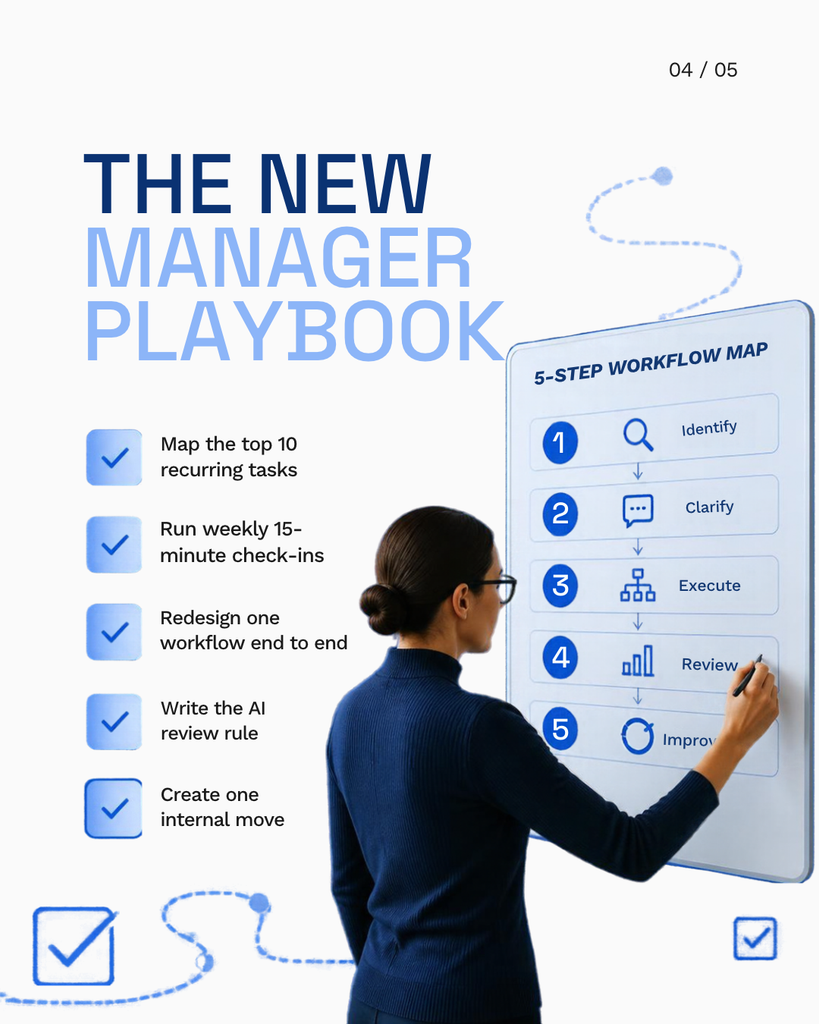
List your team’s top ten recurring tasks. For each, mark whether AI could do it, assist with it, or should stay away. Do this with the team, not for them.
Book weekly 15-minute check-ins. Gallup recommends short, frequent conversations of 15 to 30 minutes. Use them to ask one question: what part of your work changed this week, and what would help?
Pick one workflow to redesign end to end. Ship it, measure it, and share what you learned. We covered how to sequence this kind of work in The 90-Day AI Sequencing Playbook.
Write down your review rule for AI output. One paragraph is enough. Who checks, how often, and what triggers a second look.
Create one internal move. A stretch assignment, a rotation, a new responsibility. Something that gives a person a path when the company-wide ladder feels stuck.
Some teams will be ready to run this across a whole department. For them, the AI Readiness Assessment Complete Toolkit adds a stakeholder interview guide and a 90-day roadmap template.
What would change our mind?
Two things would. First, solid outcome data showing aggressively flattened teams keep productivity and engagement steady for two years or more without added investment in manager skills. Second, evidence that AI tools can reliably do the coaching and redesign work, not just the admin. We haven’t seen either yet. Citi’s results are strong, but as Fortune notes, it’s hard to prove the flatter structure caused them.
Until then, the evidence points one way. Deloitte cites INSEAD research finding that 80% of transformation programs led by middle managers succeed, compared with 20% led by senior management. AI adoption is a transformation program running in every team at once.
The organizations that see this early will invest in their managers as redesigners and coaches. The wider structure has to support them too. The free Enterprise AI Operating Model Blueprint covers the organization and talent layers. Download it to see how AI roles fit around managers without hollowing out the middle.
This connects to a pattern we flagged in Companies Are Using AI Everywhere, Making Money Nowhere. Tools spread fast, and value shows up where someone redesigns the work around them. That someone is usually a manager with a free hour and a reason to use it.
Which hour of your week could you give back to your team starting Monday?