Physical Address
304 North Cardinal St.
Dorchester Center, MA 02124
Physical Address
304 North Cardinal St.
Dorchester Center, MA 02124


AI readiness is not a single score. It is a shape across six capability dimensions. The 6 I's framework maps that shape so organizations can see exactly where they are strong, where they have gaps, and what to work on first.
Most organizations assess AI readiness by checking one thing; their technology stack. Can our systems handle AI? Is our data clean? Do we have the compute?
Those questions matter. But they are only one dimension out of six. Deloitte’s 2026 State of AI in the Enterprise found that only about 34 percent of leaders say they are genuinely reimagining their business with AI. The majority are bolting AI onto workflows designed for a pre-AI era. The technology shipped; the operating model did not.
That is an organizational readiness failure wearing a technical costume.
The 6 I’s framework evaluates AI readiness across six capability dimensions that, together, capture everything it takes to make AI work in practice. Each dimension asks a specific question. The sequence is deliberate.
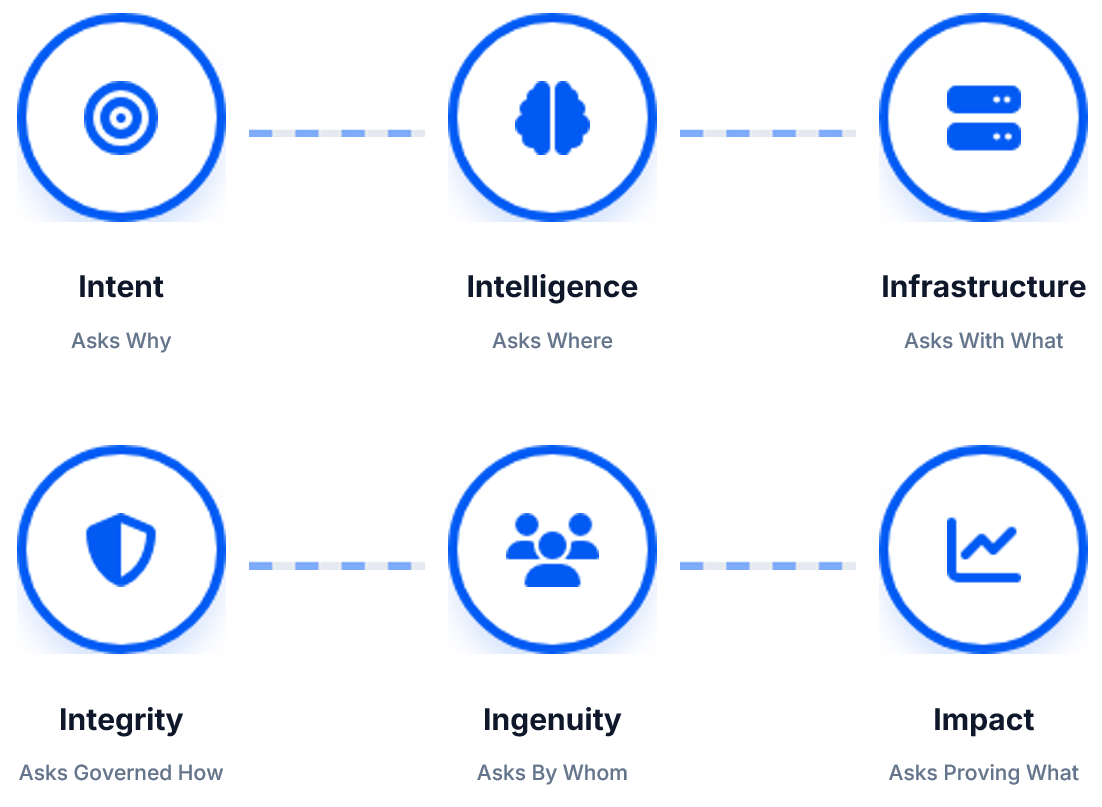
Intent asks “why are we doing this?” Strategy, vision, alignment, use-case prioritization, executive sponsorship, and business case. Intent is about having a real strategy, not just enthusiasm. A CEO mentioning AI in all-hands meetings is not Intent. A prioritized list of use cases tied to specific business objectives is Intent.
Intelligence asks “where does AI fit?” Process understanding, decision architecture, and workflow mapping. Before you can augment work with AI, you need to understand the work itself. Which decisions are rule-based and automatable? Which are judgment-based and augmentable? Which are creative? Organizations that skip this step build technically sound solutions for the wrong problems.
Infrastructure asks “with what?” Data quality, technology stack, integration architecture, security posture, and operational capacity. This is the dimension most people think of when they hear “readiness.” Gartner’s 2025 research found that only 12 percent of organizations have data of sufficient quality to support AI applications. Infrastructure matters; it is just not the whole story.
Integrity asks “governed how?” Governance frameworks, ethics, compliance, risk management, decision rights, and accountability. This dimension has grown the fastest in importance. AI-related incidents rose 55 percent year-over-year in 2025, with Stanford HAI recording 362 incidents. Organizations without governance are building capability without guardrails.
Ingenuity asks “by whom?” People, skills, culture, change management, role redesign, and adoption. Only 24 percent of individual contributors strongly agree their organization has prepared them to use AI effectively. AI is a team sport; this dimension assesses whether the team is ready to play.
Impact asks “proving what?” Measurement, KPIs, baselines, feedback loops, ROI methodology. Without Impact, organizations cannot distinguish between AI that is working and AI that is merely running. And AI that is merely running has a limited budget cycle.
The 6 I’s are not a random list. They follow the natural logic of building something that lasts. Intent (why) leads to Intelligence (where), which informs Infrastructure (with what), which requires Integrity (governed how), which depends on Ingenuity (by whom), which is validated by Impact (proving what).
Start with purpose. End with evidence. That sequence is the difference between an AI initiative and an AI operating model.
When you assess an organization across the 6 I’s, you produce a gap profile; a shape that reveals the specific imbalances that will determine success or failure. A balanced shape means the organization is developing evenly. A jagged shape with spikes and valleys tells you exactly where the blockers are.
Five common patterns emerge from assessments.
The balanced profile scores within one point across all dimensions. These organizations are developing evenly and should focus on raising the overall level rather than fixing a single dimension.
The front-loaded profile scores high on Intent and Intelligence but low on everything else. Strategy without execution. The most common pattern for organizations at the early stages.
The Integrity dip scores 3-4 on most dimensions but drops to 1-2 on Integrity. This is the governance gap; and it is the single most common pattern across organizations in 2026. With 78 percent of enterprises unprepared for EU AI Act compliance, this gap is increasingly the thing that prevents deployment at scale.
The 6 I’s framework works because it is comprehensive without being complicated. Six dimensions are enough to cover every aspect of readiness. The questions are specific enough to score. The scoring is consistent across dimensions. And the gap profile it produces is visual, shareable, and actionable.
Most importantly, it shifts the conversation from “are we AI ready?” (a binary question with no useful answer) to “where are we strong and where do we have gaps?” (a profile that leads directly to a roadmap).
If you have never assessed your AI readiness, the first step is simpler than you think.
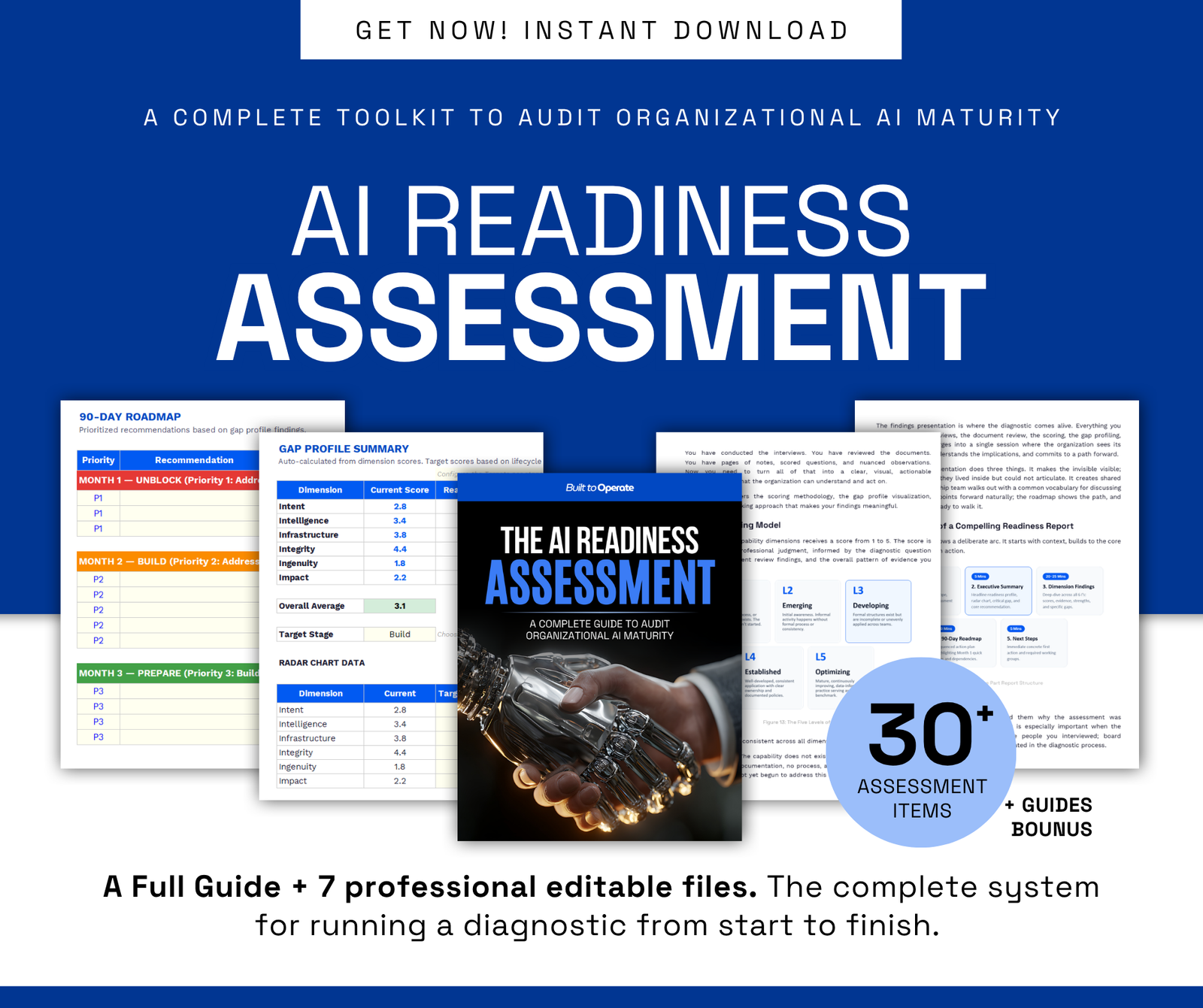
The full Assessment toolkit uses 30 scored questions with detailed rubrics, stakeholder interviews, document review, gap profiling, and a 90-day roadmap. It is designed to work whether you are assessing your own organization or helping someone else assess theirs. Get it in link below
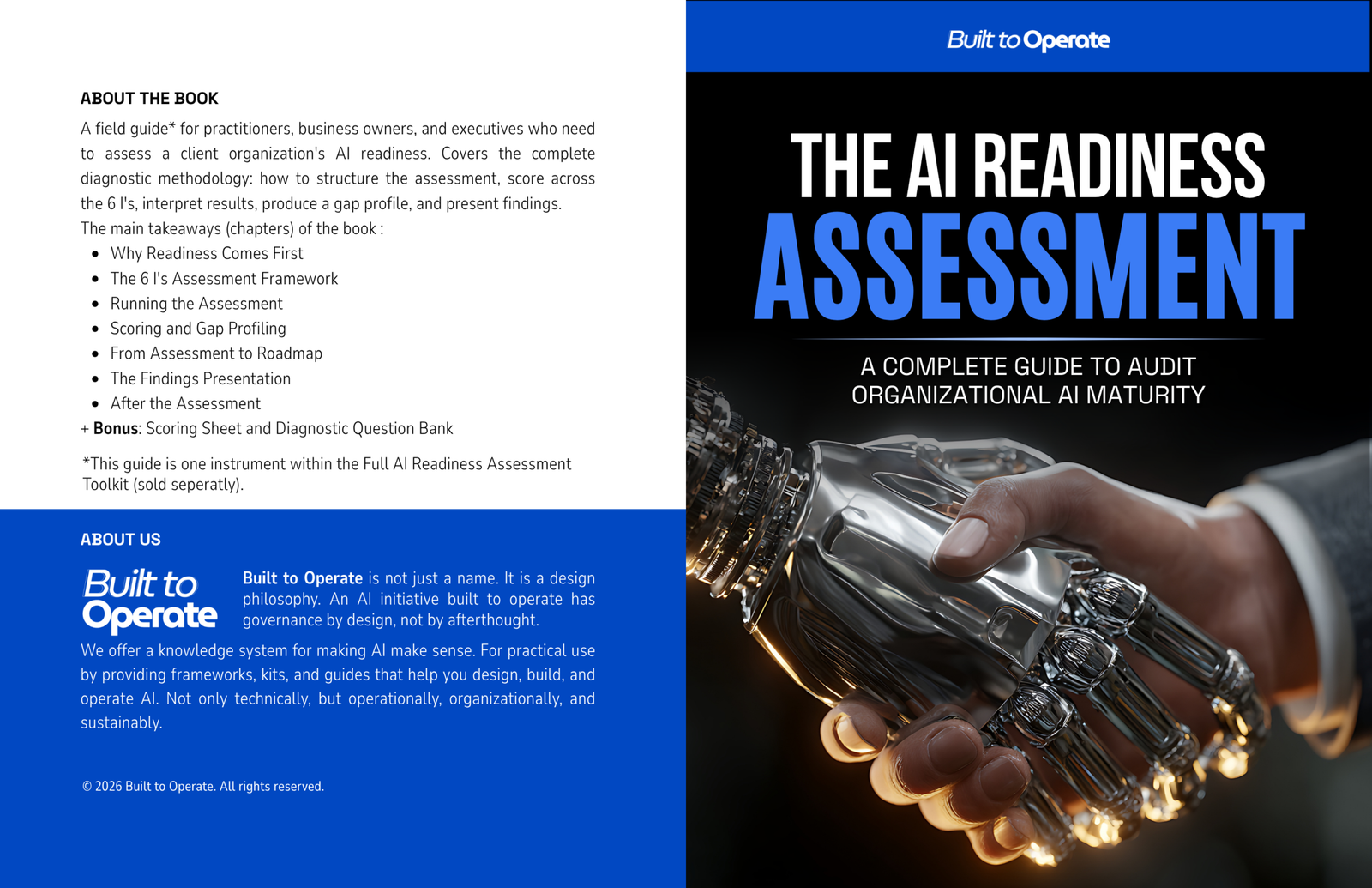
The AI Readiness Diagnostic book covers the complete assessment methodology. The AI Readiness Assessment Toolkit includes the book plus 8 professional files; the Scoring Workbook, Interview Guide, Document Review Checklist, Findings Report Template, Executive Summary, 90-Day Roadmap Template, Findings Presentation, and Re-Assessment Tracker. Explore both at builttooperate.com.