Physical Address
304 North Cardinal St.
Dorchester Center, MA 02124
Physical Address
304 North Cardinal St.
Dorchester Center, MA 02124


The highest-performing AI programs do not try to do everything at once. They follow a 90-day sequencing model; discover, redesign, then scale. This playbook breaks down each phase with specific actions.
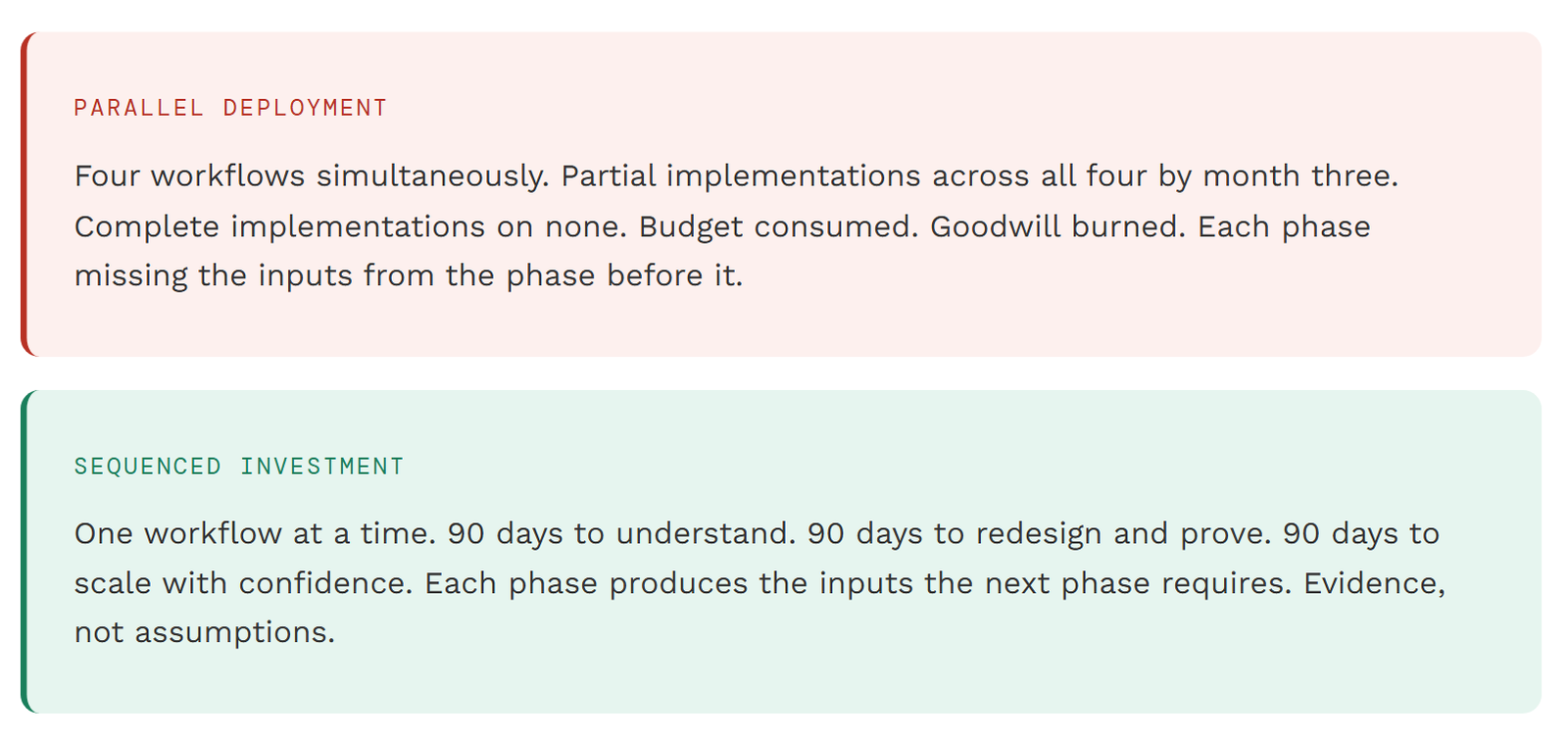
A three-person analytics team at a mid-sized logistics company tried to deploy AI across four workflows simultaneously last year. They had budget. They had executive support. They picked reasonable use cases. By month three, they had partial implementations in all four and complete implementations in none.
I keep hearing versions of this story. Smart teams. Good intentions. But the order of operations was wrong.
The enterprises getting real results from AI in 2026 share one pattern: they sequence their investments instead of parallelizing them. The model that surfaces across multiple independent analyses is a 90-day cycle. Three phases. Each one produces the inputs the next phase requires. Skip a phase and the whole thing wobbles.
This is the playbook.
The instinct to do everything at once makes sense on paper. You have finite budget windows. Leadership wants results fast. Multiple departments are asking for AI. Running four projects simultaneously feels faster than running them sequentially.
Except it is not. And the data is pretty clear on this.
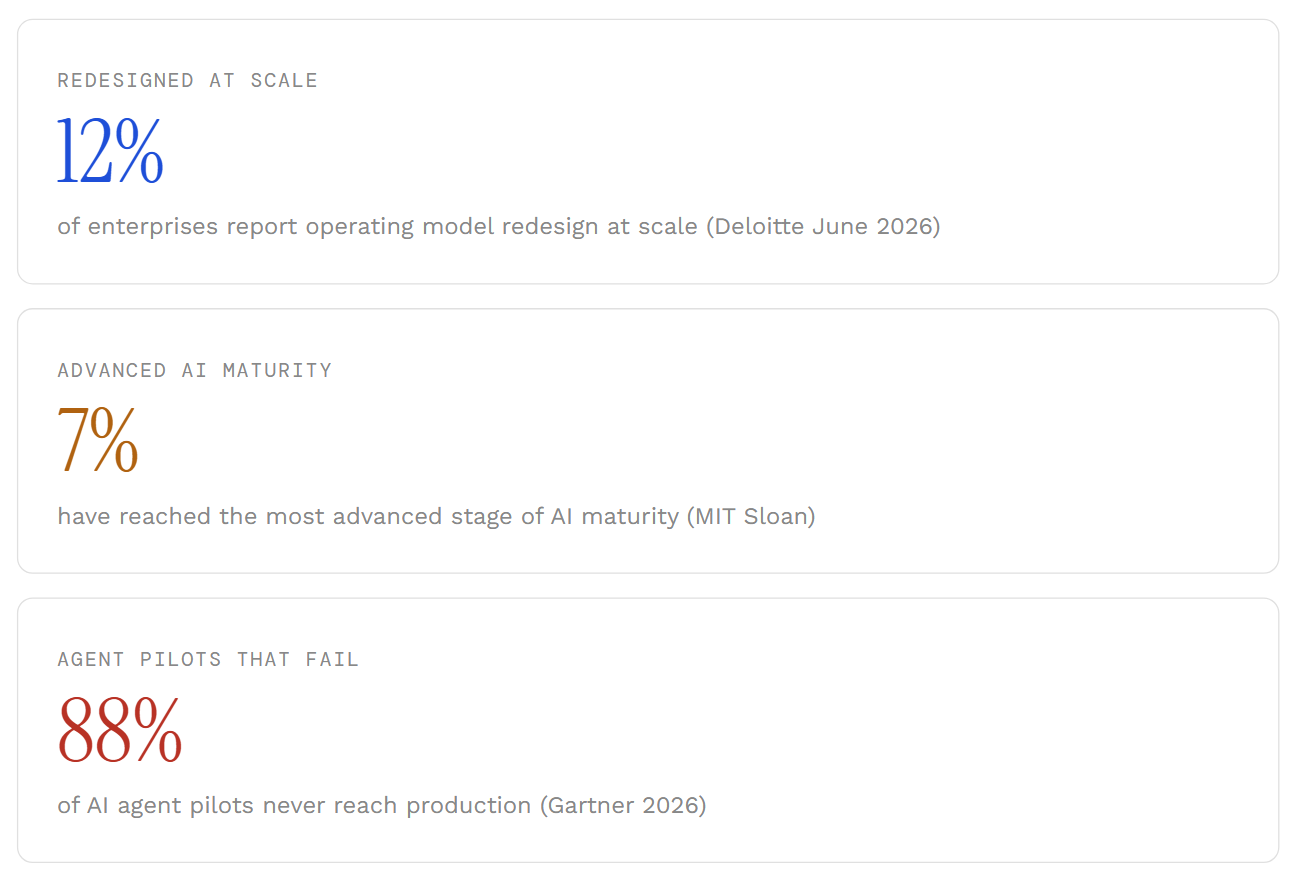
Only 12% of enterprises report operating model redesign at scale, according to Deloitte’s June 2026 pulse check. Only 7% have reached the most advanced AI maturity stage, per MIT Sloan research. 88% of AI agent pilots never reach production.
The common thread? Teams deployed tools before they understood the workflows those tools would operate in. They automated before they redesigned. They scaled before they validated.
Parallel deployment fails because each phase depends on the output of the one before it. You cannot redesign a workflow you have not mapped. You cannot scale a pilot you have not validated. And you definitely cannot do all three simultaneously without producing confusion.
We explored this dynamic in The Maturity-Based AI Roadmap; the insight is that skipping stages does not save time. It creates expensive rework later.
The first 90 days are process intelligence. No AI deployment. No agent pilots. Just understanding.
This is the phase most teams skip because it feels slow. It is the phase that determines whether everything after it works.
What you are doing: Mapping how work actually flows through the organization. Not the process diagram on the wiki. The real thing. Where work queues, where it loops, where it gets stuck, where people invent workarounds.
How: Process mining tools (Celonis, Microsoft Process Advisor, UiPath Process Mining, or for smaller teams, manual workflow observation) connect to your enterprise systems and reconstruct actual process flows from event log data. Deloitte research found that 63% of organizations discovered automation use cases they did not know existed once they ran process intelligence.
What you learn: The invisible bottlenecks. The approvals that add time but not value. The process variants; and most organizations have far more than they expect. A “standard” order-to-cash process might have 40+ path variants when you actually mine the data.
What you produce: A process map grounded in reality. A list of candidate workflows for AI augmentation, ranked by impact and feasibility. A baseline measurement for cycle time, error rate, cost per unit, and throughput for each candidate.
That baseline is critical. Without it, you will spend months arguing about whether AI actually improved anything. (I have watched this argument happen. It is not productive.)
Before starting Phase 1, it helps to know where your organization sits across all readiness dimensions. The AI Readiness Assessment Matrix scores you across 10 dimensions with 40 sub-dimensions, including process maturity, data readiness, and governance. Free, and it takes about two hours for a team assessment.
Now you know what the work actually looks like. Phase 2 is about redesigning the top candidate workflows for AI execution and running small-scale pilots.
This is where most teams make a subtle but expensive mistake. They take the workflow as it exists and ask “where can we add an AI agent?” Kai Waehner’s 2026 analysis articulates why that is the wrong question; a process built for human execution is rarely the right foundation for an autonomous one.
The right question is: if we were building this workflow from scratch for an agent, what would it look like?
What you are doing: Taking the 2-3 highest-impact candidates from Phase 1 and redesigning them. Cleaning up the approval chains. Removing steps that exist because “we’ve always done it that way.” Defining clear decision points where agents act and where humans intervene.
Then, piloting the redesigned workflow with AI agents on a small scale. One team. One geography. One product line.
What you learn: whether the redesigned workflow actually works when an agent operates it. Where the agent fails (and it will; LangChain’s 2026 survey found quality is still the #1 barrier, cited by 32% of respondents). Where human oversight is essential versus where it is theater.
What you produce: A validated workflow that works at small scale. Performance data comparing the AI-augmented process against the Phase 1 baseline. A list of integration, security, and governance requirements for Phase 3.
This is also where governance needs to be in place; not as a blocker but as a structure that enables confident scaling. The relationship between governance and scale is something we addressed in AI Adoption: A Guide to Assessing Organizational Readiness. If your governance framework is not built yet, the Enterprise AI Operating Model Blueprint includes a three-tier governance model (Strategic, Tactical, Operational) alongside the full six-layer operating model. Free download.
Phase 3 is broader deployment of validated workflows with continuous monitoring.
The keyword is “validated.” You are scaling what worked in Phase 2, not what you hoped would work. This is why the sequencing matters; you arrive at Phase 3 with evidence, not assumptions.
What you are doing: Rolling out AI-augmented workflows across additional teams, geographies, or business units. Onboarding users. Adjusting for local variants. Integrating with production systems at full scale.
What is different from Phase 2: Scale introduces problems that do not show up in pilots. Nearly 60% of AI leaders say legacy integration is a primary adoption challenge. The workflow that worked cleanly in one office might collide with a different ERP configuration in another. The agent that handled 50 requests per day might behave differently at 5,000.
The observability layer: This is where process mining comes back. It does not end after Phase 1. In the strongest implementations, process mining continues as the observability infrastructure for AI agents in production. It catches drift (when agent behavior shifts over time), detects new process variants emerging, and flags when the workflow needs another redesign cycle.
Organizations implementing this pattern report 70-80% reduction in process cycle times. Not because the AI was more advanced. Because the sequence ensured the AI was applied to the right process, designed for the right workflow, and monitored for the right outcomes.
What you produce: Production-scale AI deployment with measurable business impact. An observability system that catches problems before they compound. A repeatable model you can apply to the next workflow.
Something interesting happens when you complete the full 270-day cycle. You do not start the next cycle from scratch.
Phase 1 gets shorter because you already have process mining infrastructure running. Phase 2 gets faster because your teams have redesign experience and governance frameworks in place. Phase 3 gets smoother because your integration patterns are established.
The 85% of leaders who say building organizational adaptability is critical? This is how you actually build it. Not through training programs (though those help). Through repeated cycles of discover-redesign-deploy that make the organization structurally better at absorbing change.
By cycle three or four, the 90-day phases compress. The sequencing muscle becomes organizational capability. What started as a playbook becomes a permanent operating rhythm.
For teams that want to see how this sequencing model connects to the broader arc of AI maturity, The Maturity-Based AI Roadmap maps out what to do at each stage and, just as importantly, what never to do regardless of stage.
A few honest questions before you start.
Can you name the three workflows where AI would create the most business impact? Not “AI in general would be useful” but specific workflows with specific bottlenecks. If you cannot, Phase 1 will help you answer that question, which is exactly the point.
Do you have access to event log data from your core systems? Process mining needs data trails. If your workflows live entirely in email and spreadsheets (and many do), you will need manual observation before automated mining.
Is there executive sponsorship for a 90-day discovery period that does not produce AI deployment? This is the hardest sell. The answer is usually easier than you think once you frame it as: “we want to make sure we automate the right thing the first time instead of the wrong thing twice.”
For practical AI application examples tied to real workflows, BTO’s Enterprise AI Operating Model demonstrates what workflow-aware AI looks like.
I used to think the hardest part of AI transformation was choosing the right model or building the right infrastructure. I do not think that anymore. The hardest part is getting the sequence right.
Deloitte’s 2026 analysis says the gap between “AI added” and “AI transformed” is showing up in board-level performance data. The 12% who have redesigned at scale are the ones who sequenced their work. The other 88% tried to skip steps.
The 90-day model is not a silver bullet. (Nothing is.) But it aligns your investment with how organizational change actually works: in phases, with feedback loops, where each phase earns the confidence to take the next step.
Start with what you can see. Redesign what you understand. Scale what you have proven.
That is the sequence. And it works.