Physical Address
304 North Cardinal St.
Dorchester Center, MA 02124
Physical Address
304 North Cardinal St.
Dorchester Center, MA 02124


95% of enterprise AI pilots deliver no measurable return. The explanation is not weak models. It is organizations that were not ready. Assessment before implementation is the pattern that separates teams that scale from teams that stall.
An MIT research initiative studying over 300 enterprise deployments found that roughly 95 percent of corporate generative AI pilots delivered no measurable return. The finding that matters is not the number. It is the explanation.
The failures were not caused by weak models. They were caused by organizations that were not ready to absorb what they built.
Meanwhile, McKinsey’s 2025 State of AI survey reported that 88 percent of respondents said their organizations used AI in at least one business function. Adoption is near-universal. Impact is not. The gap between deploying AI and proving it works has a name; it is a readiness gap.
The organizations that consistently move AI from pilot to production share three traits. They have a named executive sponsor. They have a defined success metric tied to a business outcome. And they have at least one internal AI champion who bridges the gap between strategy and daily operations.
But before any of those traits can take hold, something else has to happen first. Someone has to assess where the organization actually stands; honestly, structurally, across multiple dimensions; before resources get committed. Cisco’s annual research has consistently found only about 13 percent of organizations qualify as fully prepared for AI at scale. That share has stayed stable even as general AI enthusiasm has surged.
The readiness assessment is not a delay. Four weeks spent measuring readiness routinely saves six months of budget spent on the wrong scope.
A structured readiness diagnostic does not just confirm what you already suspect. It surfaces things you cannot see from inside the organization.
Consider a mid-sized professional services firm that invested six months building an AI-powered document review workflow. The technology worked. The prompts were well-engineered. But the firm had no data governance policy, no clear decision rights about who could approve AI-generated work, and no change management plan for the teams whose daily routines would shift. Six months of technical work met three weeks of organizational friction, and organizational friction won.
A diagnostic at the start would have surfaced those gaps. The firm could have built governance alongside the technology. The six-month project might have taken seven months; but it would have stuck.
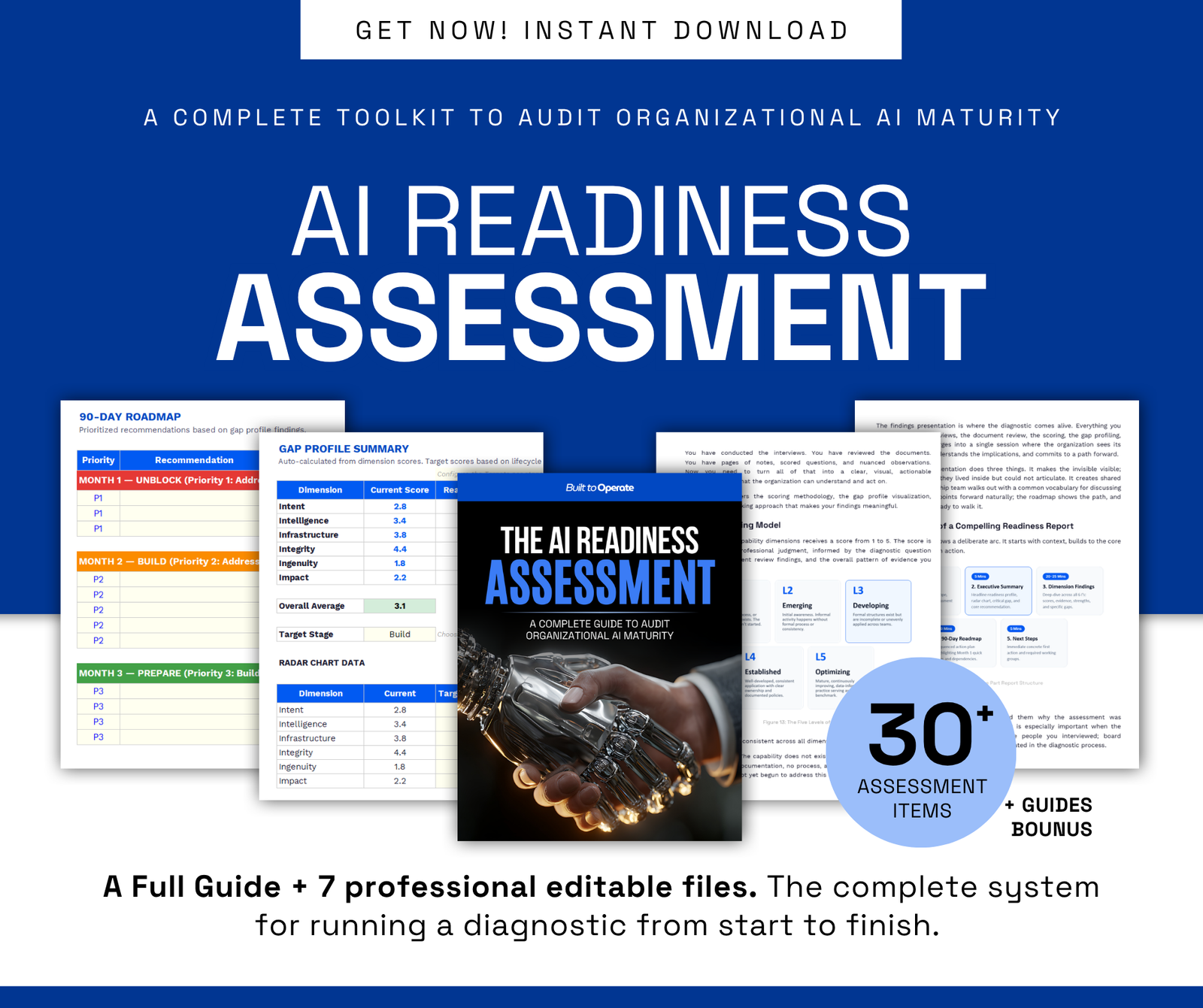
Readiness is not a single score. It is a profile across multiple capability dimensions: strategy, process understanding, infrastructure, governance, people readiness, and measurement capability. Each dimension captures a distinct aspect of what it takes to make AI work in practice.
The most common imbalance across organizations is what we call the governance gap. Only about 8 percent of organizations globally have a comprehensive AI governance framework, even though 88 percent are actively using AI. That is capability running ahead of guardrails, and with the EU AI Act reaching full enforcement in August 2026, that gap is about to get expensive.
The second most common imbalance is the people gap. Deloitte’s 2026 State of AI in the Enterprise found that insufficient worker skills are the single biggest barrier to integrating AI into existing workflows. Organizations deploy tools before preparing the people who will use them.
The organizations that get the most from readiness assessment treat it as a recurring practice, not a one-time gate. Every six to twelve months, they re-assess, comparing the current profile to the previous one, adjusting the roadmap based on what they have learned, and tracking the trajectory of improvement.
That re-assessment cadence creates three things no one-time assessment can. First, it makes progress visible; leadership teams can see their investment reflected in the changing shape of the gap profile. Second, it catches new gaps before they become blockers; as the organization moves from one lifecycle stage to the next, different dimensions become critical. Third, it builds the data that makes future assessments more meaningful; after multiple cycles, the organization has benchmarks that give every score context.
If you have never assessed your AI readiness, the first step is simpler than you think.
The full Assessment toolkit uses 30 scored questions with detailed rubrics, stakeholder interviews, document review, gap profiling, and a 90-day roadmap. It is designed to work whether you are assessing your own organization or helping someone else assess theirs. Get it in link below
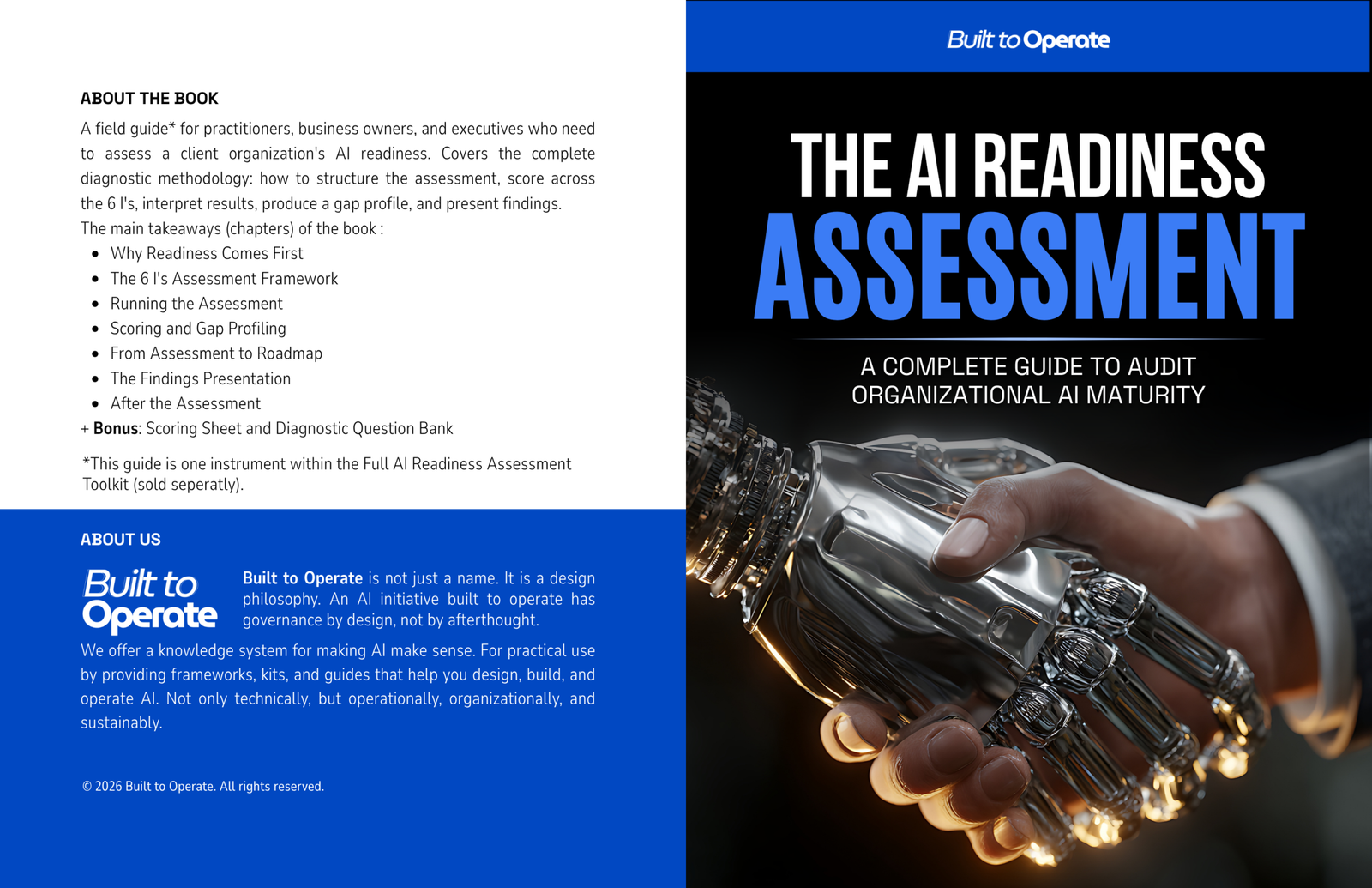
The AI Readiness Diagnostic book covers the complete assessment methodology. The AI Readiness Assessment Toolkit includes the book plus 8 professional files; the Scoring Workbook, Interview Guide, Document Review Checklist, Findings Report Template, Executive Summary, 90-Day Roadmap Template, Findings Presentation, and Re-Assessment Tracker. Explore both at builttooperate.com.